In the years since the fires swept across Sonoma County, two local homegrown initiatives have broken through to national prominence. One is Watch Duty, the app that gathers information on wildfires and makes it available to anyone with a cell phone, cobbled together by Santa Rosa software engineer and entrepreneur John Mills. So successful has the app become that CalFire recently launched its own version, AwareCA.
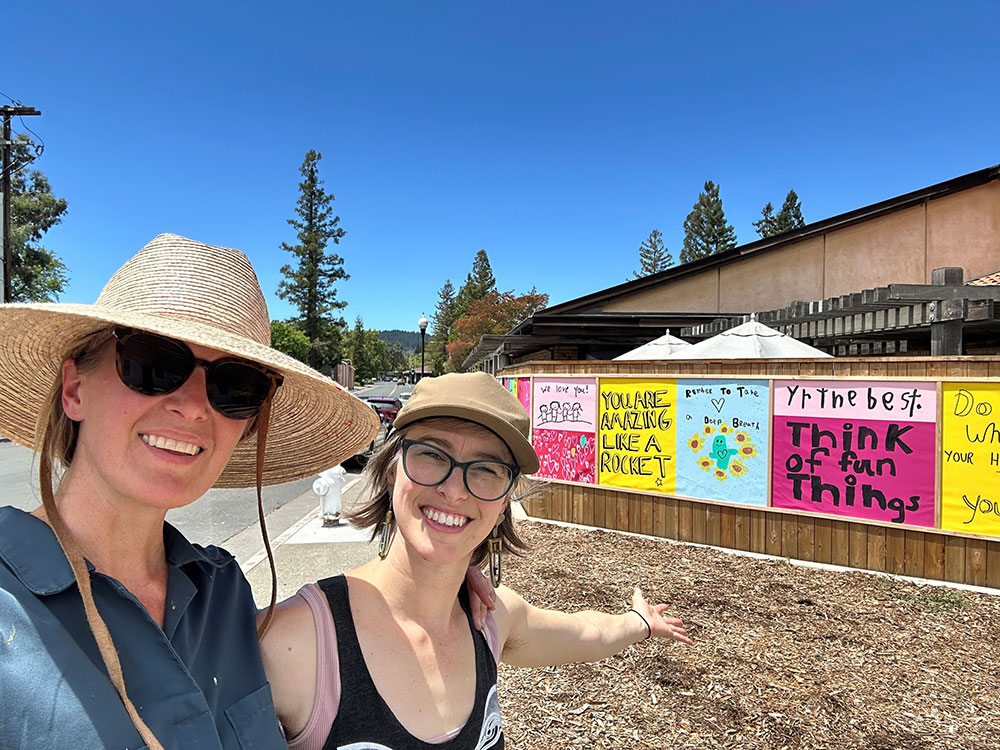
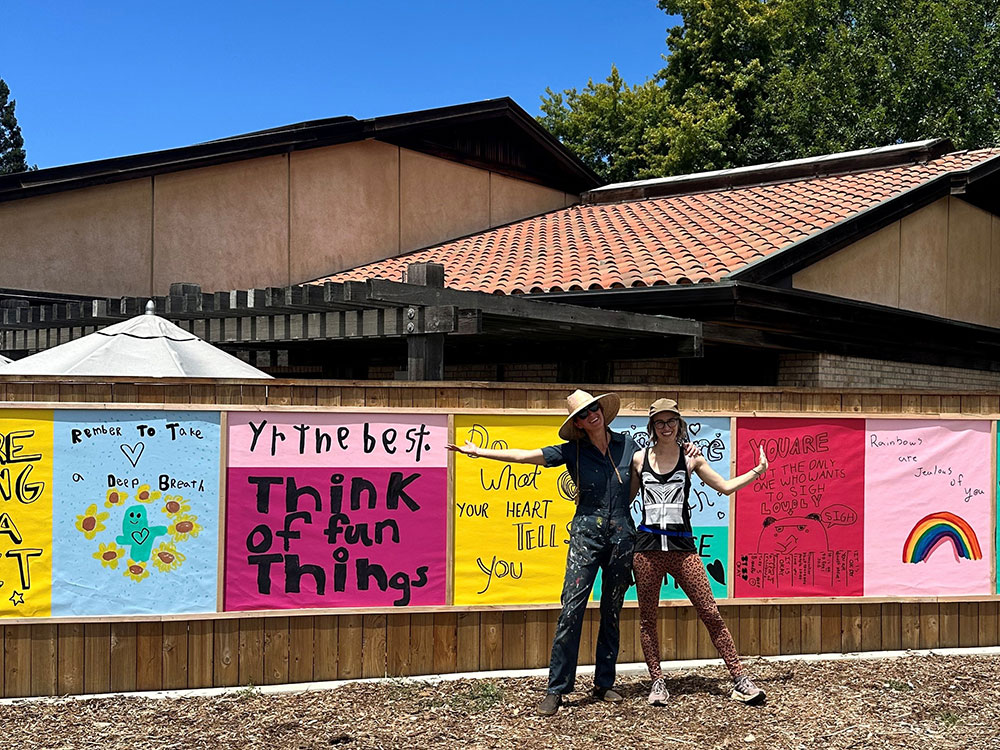
The other is Peptoc—a phone line that anyone can call and get a “pep talk” from Westside School students. It’s a public arts project, created by Jessica Martin and Asherah Weiss when their teaching careers overlapped at the small public school just outside Healdsburg.
“It was right after we had a series of fire evacuations, and right after the Covid pandemic,” said Martin, who worked with the Westside elementary students as an art teacher every day. “I really was astounded at their resilience and their kindness to one another. And I wanted to have our community share that.”
At first the two teachers asked their students to write down words of advice and wisdom, from which posters and stickers were made. “Then I had this idea to make a hotline that our community could call, and I recorded them giving their pep talks,” Martin said. The “hotline” was launched, by coincidence, the day Russia invaded Ukraine.

Then someone posted the number online. “It immediately went viral,” understated Martin. A graphic on the Peptoc Instagram page shows calls spiking from a negligible amount on Feb. 23, 2024, to over 150,000 the next day, and 200,000 the day after that. “We were getting 60,000 calls an hour, from all over the world,” said a still-amazed Martin.
The downside of that sudden success came soon. “I woke up a few days later to an email from my credit card saying that I owed $45,000 on my credit card statement,” she said. The reason was simple: telephone “hotline” services charge for each call received, and while it’s not a lot, it adds up.
“Whenever someone calls our hotline, we’re paying for that. It’s really very slim; I think it’s like .006 cents,” Martin said. “I’m not sure exactly what it is, but we’re paying pennies for each call. But if someone posts the line on social media and they have 3 million followers, that could potentially be a $25,000 day for us.”
When the project started, Martin googled “hotline providers” and signed up for a $100 package with a startup. “Thinking that we’d keep it up for a month or two and then that would be it, and I’d get maybe 50 calls,” he said.
When the numbers exploded, it became clearly necessary to upgrade the hotline service to one capable of handling the extraordinary number of calls that came in. Peptoc signed up with Twilio, “one of the largest telecommunication software companies in the world,” Martin said. “They literally coded a hotline program just for us.”
What’s that number again?
Though “pep talk” is what the service offers, the signature spelling “Peptoc” came from Jessica Martin’s son August, then in first grade at Westside. “I wanted to keep a 707 number, and we could make that work,” she said. The 707-8-PEPTOC phone number, still functional, is answered in the voices of several school-age children, in English and Spanish.
“Hi, Welcome to Peptoc, a public arts project by West Side School. Please listen to the following options for encouraging messages. If you’re feeling mad, frustrated or nervous, press 1. If you need words of encouragement and life advice, press 2. If you need a pep talk from kindergartners, press 3. If you need to hear our kids laughing with delight, press 4. To hear how awesome you look, press 6 …”

The project’s sudden and explosive success put everything in a new light for the two artists, and they realized they needed to become a nonprofit to take fullest advantage of its success by gaining access to donations and grant funding. They were connected with Chris Schultz, whose Launch Pad Foundation could provide “fiscal agent” status for Peptoc.
“Launch Pad helps community builders operate charitable work responsibly without asking them to create a standalone institution before the work is ready,” Shultz states on his foundation’s website, lp.foundation. Launched in New Orleans in 2009, Launch Pad is best known locally for its Analog Reunion concert (formerly Cosmico). It is now engaged in “inviting community builders nationwide to seek financial sponsorship for projects that bring people together in real life,” a project known as Spark.
Other local projects working with Launch Pad include the Healdsburg Dance Collective, Catalyst @ CraftWork and Trip the Light Fantastic at Villa Chanticleer.
“We’re probably their poster child for what they want to do,” Martin said. “You know, it was just this very simple idea that then became huge. They were there to help us continue to grow.”
Martin acknowledges, with an undiminished sense of wonder, “This is a project that completely changed the trajectory of our careers and our lives.”
Deadline for applying for “Spark” status and support from Launch Pad is Oct. 10. For more information and to apply, visit lp.foundation or contact Chris Schultz at ch***@**.co.