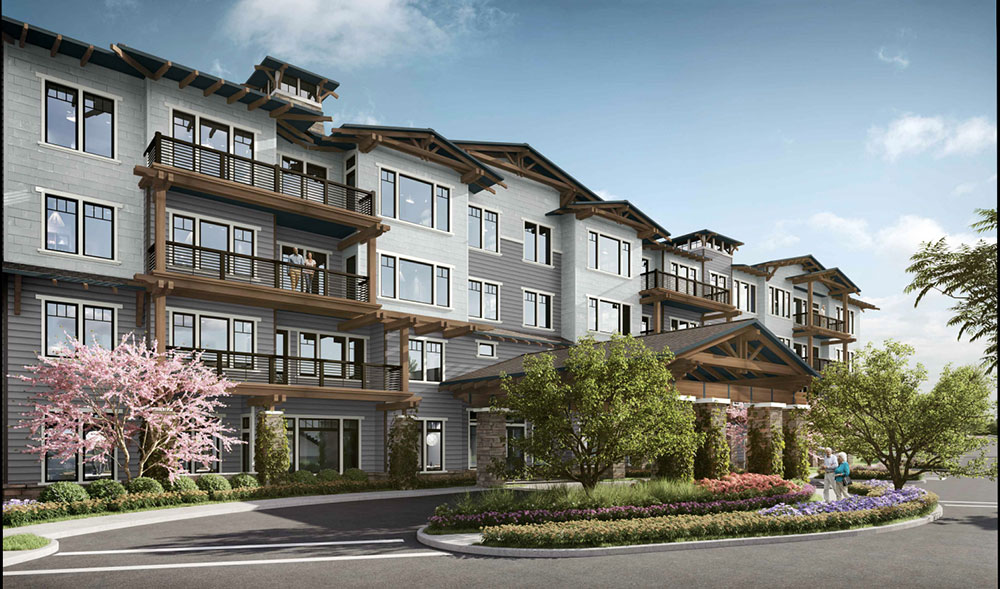
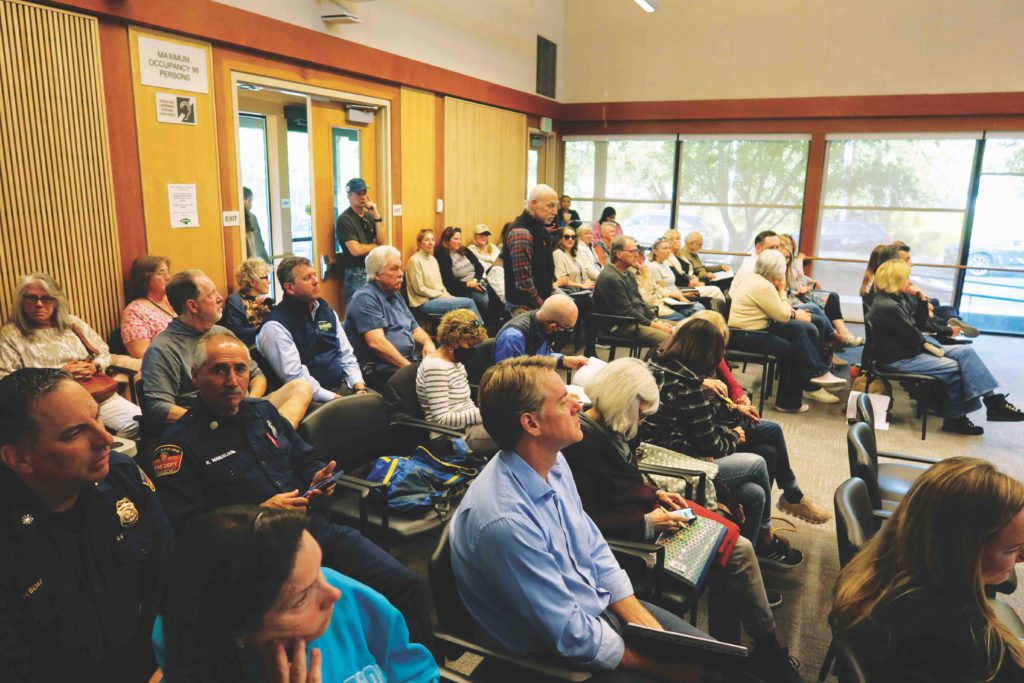
When the Healdsburg Planning Commission met on Aug. 11 to evaluate a senior housing project at 359 Hudson St. , an evening of differing opinions was expected. Disappointingly to most in the room, following extensive public comment and vain attempts by commission members to extract any compromise whatsover, the conditional use permit was approved. The reason for the unanimous acceptance was due to state “density bonus” laws that essentially forbid a city from rejecting a plan that meets all the formal requirements for acceptance.
While our newspaper deadlines prevented a full report from that meeting, we publish this article to air the main objections logged before the meeting took place by write-in public comment. Most of these objections were aired at the meeting as well.
The project is called The Hudson by its developers, Gallaher Signature Living, as one of their several continued care retirement communities including the Varenna in Santa Rosa and the Morella in Petaluma. As the project proposal says, “The proposed project would redevelop the approximately 3.61-acre site with a four-story senior living building containing 67 independent and assisted living units, a single-story memory care building with six treatment rooms and one manager’s unit, and a separate building containing 10 deed-restricted affordable workforce housing units.”
The large number of units, 77 total, is made possible by the developer’s request of a 50% Density Bonus, based upon the number of affordable units proposed. Under established density standards for this project site size of 3.61 acres, the maximum number of allowed units is 51 units; the density bonus adds another 26 to that number.
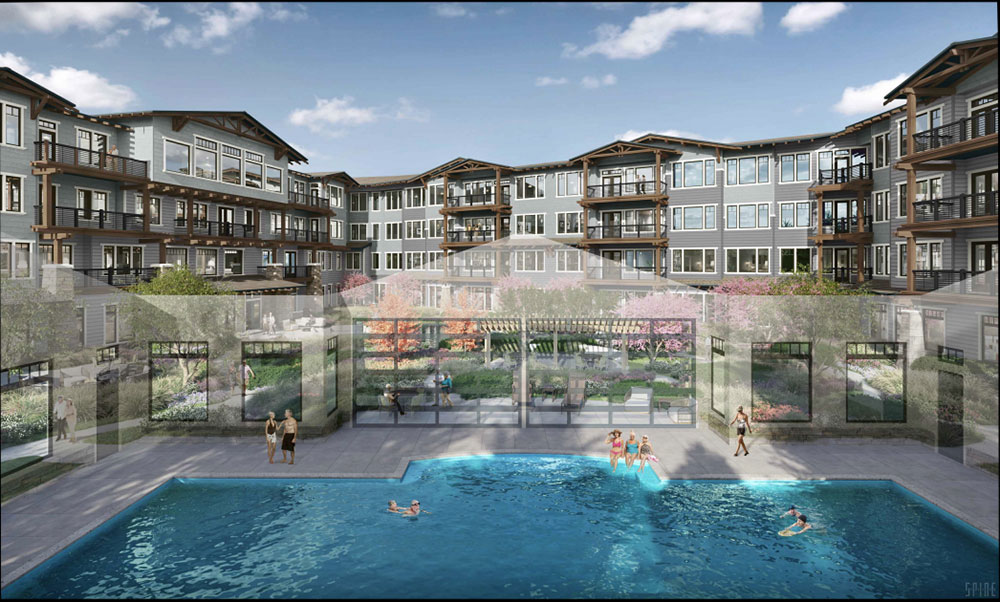
Several different types of “density bonuses” can be claimed, under a state law encouraging development of affordable housing, as well as additional incentives” or “concessions” to each project qualifying for a density bonuses. In this case, the Hudson has requested a waiver of the 10-foot setback requirement, waiving the Land Use Commission (LUC) requirement that residents of inclusionary units must have access to common open space and recreational amenities, and waiving an LUC requirement that 10% of affordable units to be three-bedroom units. Accordingly, there is no three-bedroom unit in the proposed complex.)
Another density bonus waiver was asked to increase the allowable height of buildings from 35 feet for abutting residential zones to 58’8”, a substantial increase for the residential zone (and a major source of dissatisfaction among nearby residents.) Yet. as the proposal states, with the circular reasoning such proposals often adopt, “The applicant is requesting a State Density Bonus Waiver to increase the allowable height in order to accommodate the allowable density bonus.”
Former Housing Committee member Bruce Abramson addressed this reasoning in his letter to the Planning Commission. “The developer may be legally right for requesting this exemption, but he should also be ethically responsible to community norms and existing affordable examples.”
Another of their requested three waivers was that the affordable housing not be “consistent in square footage, quality of finishes, and amenities to market rate units.” In their place Gallaher is proposing small 350-square foot studios, targeted to “worker housing” that could be rented to Gallaher employees. By calling it worker housing, but designating it for Gallaher employees, it violates the city’s municipal code that density bonus residential units “shall be made available on a non-discriminatory basis.” It also discriminates against people without jobs, again in violation of the city’s government code.
Those objections were raised in one of two joint statements by Lewis Bangham, a noted artist who lives close to the Hudson Street project site, and Jon Eisenberg, a retired lawyer who has often disagreed with the city over issues of code and policy.
Another of their letters points out the “by right” approval of the conditional use permit the Hudson seeks is based on “residential care, general.” That is defined by the city as “non-medical residential care, day treatment or foster agency services for seven or more adults and/or children as defined by the California Health Safety Code.”
They hold that Gallaher and company are in fact proposing a “Continuing Care Retirement Community” (CCRC), a facility that “houses seniors and provides both medical and non-medical residential care.” Bangham and Eisenberg say the project as a CCRC should not be permitted under the terms of the city’s Mixed-Use zoning regulations, because it will not be a general residential care facility and thus should be disqualified.
Another comment by letter in the packet available before the meeting comes from writer Marie Butler, who brings up another factor that is not directly one of code. “I am still haunted by the way seniors were abandoned during the Tubbs fire at two of Gallaher’s facilities,” as described in the recent book Inflamed: Abandonment, Heroism and Outrage, by Anne Belden and Paul Gullixson.
“I am concerned about how safety procedures would be handled in a future emergency,” she writes. “And frankly I do not trust this developer to do what is right for seniors. Or for the city.”
Other letters may be submitted before Tuesday night’s 6pm meeting at City Hall, which has already been widely discussed on social media among residents. Of course public comments at Planning Commission meetings can also be many and lengthy (If limited to two or three minutes each), and there’s no reason to think that the Tuesday, Aug. 11 meeting will be any different.
There is another agenda item for the Planning Commission regarding a permit extension for a planned wine tasting room on Foss Street; ths senior housing project is second. Attend the meeeting at 6pm tonight, at Council Chambers, 401 Grove St. Or view online at facebook.com/cityofhealdsburg or healdsburg.gov/zoom.