Talkin’ turkey here. Nope, not Thanksgiving turkey. Turkey tail mushrooms. It’s mushrooming season in Sonoma County. When the weather turns cold and damp, fog rolls in and rain falls, generally from October–March, and mushrooms’ fruiting bodies pop up.
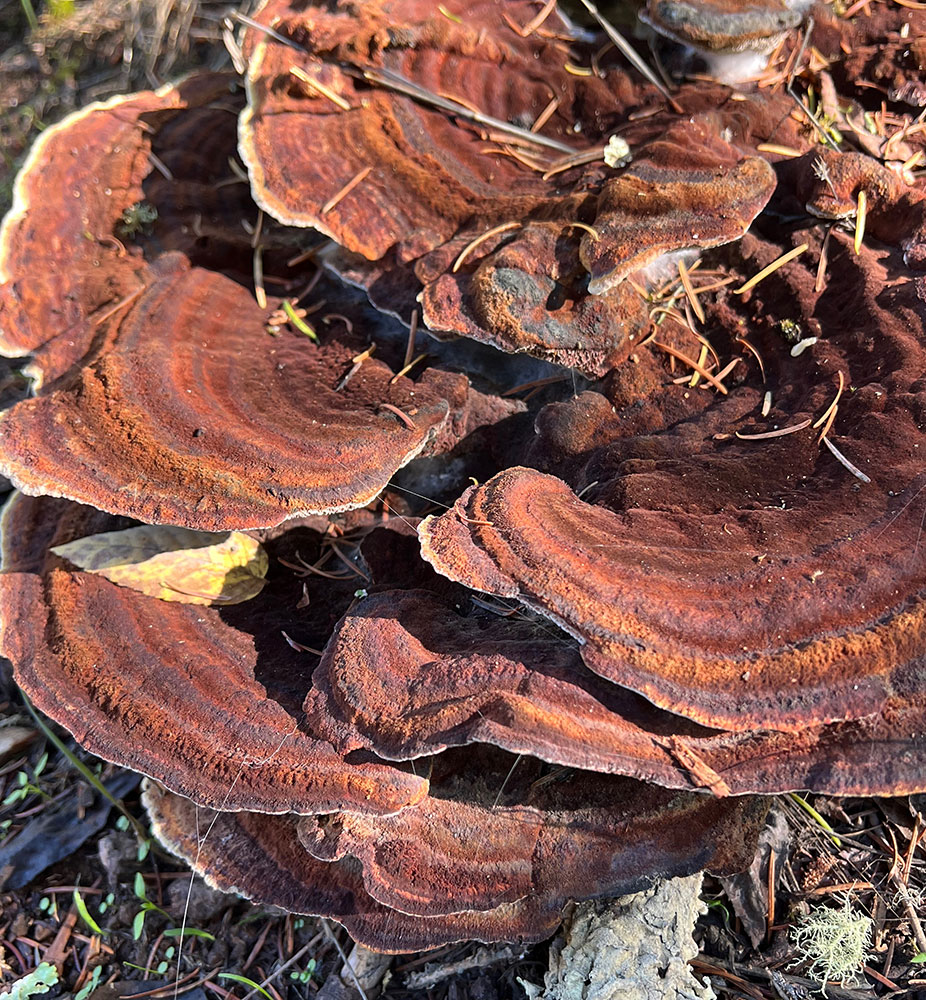
This grand specimen is a turkey tail mushroom. It’s growing on a Douglas fir stump somewhere in Sonoma County. Foragers don’t divulge locations, but with a little research one will probably be able to find some. Sonoma County’s damp forests and fields are literally chock full of mushrooms this time of year, especially this year, just waiting to kick up flavoring in a risotto, a casserole, soup or stuffing. Check with SOMA (Sonoma County Mycological Association) to learn more and possibly join a collecting foray.
Fun Facts: Sonoma County has over 1,100 species of mushrooms. Some recognizable and tasty treats include: golden chanterelles (Cantharellus californicus), California’s designated state mushroom since 2024; black trumpets (Craterellus cornucopioides); candy caps (Lactarius rubidus) tasting like maple syrup; Porcini (Boletus edulis), perfect all year round when dried; hedgehogs (Hydnum repandum); Morels (Morcella americana) with distinctly honeycombed fruiting bodies; Lion’s mane (Hercium erinaceus); and oyster mushrooms (Pleurotus ostreatus) to name a few.
The world’s largest organism may be a mushroom (Armillaria), reportedly spanning 2,300 acres devouring underground roots. It is estimated to be 2,400 years old. Mushrooms are genetically closer to humans than plants. One species has over 20,000 genders. It is the split gill mushroom (Schizophyllum commune), with a seemingly appropriate scientific name.
Mushrooms have been consumed for thousands of years. Romans referred to them as “food of the Gods.” Up to 75% of pharmaceuticals are derived from fungi, including: penicillin, discovered in 1928 from typical green-blue bread mold (Penicillium rubens); statins; cephalosporins; cyclosporines; avermectins; streptomycin and others. Besides pharmaceutical derivatives, healing properties are attributed to mushrooms. Some contain B vitamins while others contain selenium for thyroid functioning; ergothioneine, a powerful antioxidant; and Beta-glucans, which improve immune responses and reduce cancer risks.
Mushrooms also contain psilocybin, which induces altered states of consciousness. Over 200 species contain psilocybin. Different species reportedly produce different psychotropic effects: Panaeolus cyanescens produces visuals coupled with giggles, Psilocybe cyanescens (caramel caps) reportedly dissolves ego and blurs colors, and Psilocybe cubensis (golden teacher) induces euphoria and introspection. Reportedly.
Not So Fun Facts: Mushrooms can be deadly; poisonous species mimic edible species. Ingesting without certainty is not recommended.