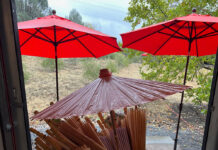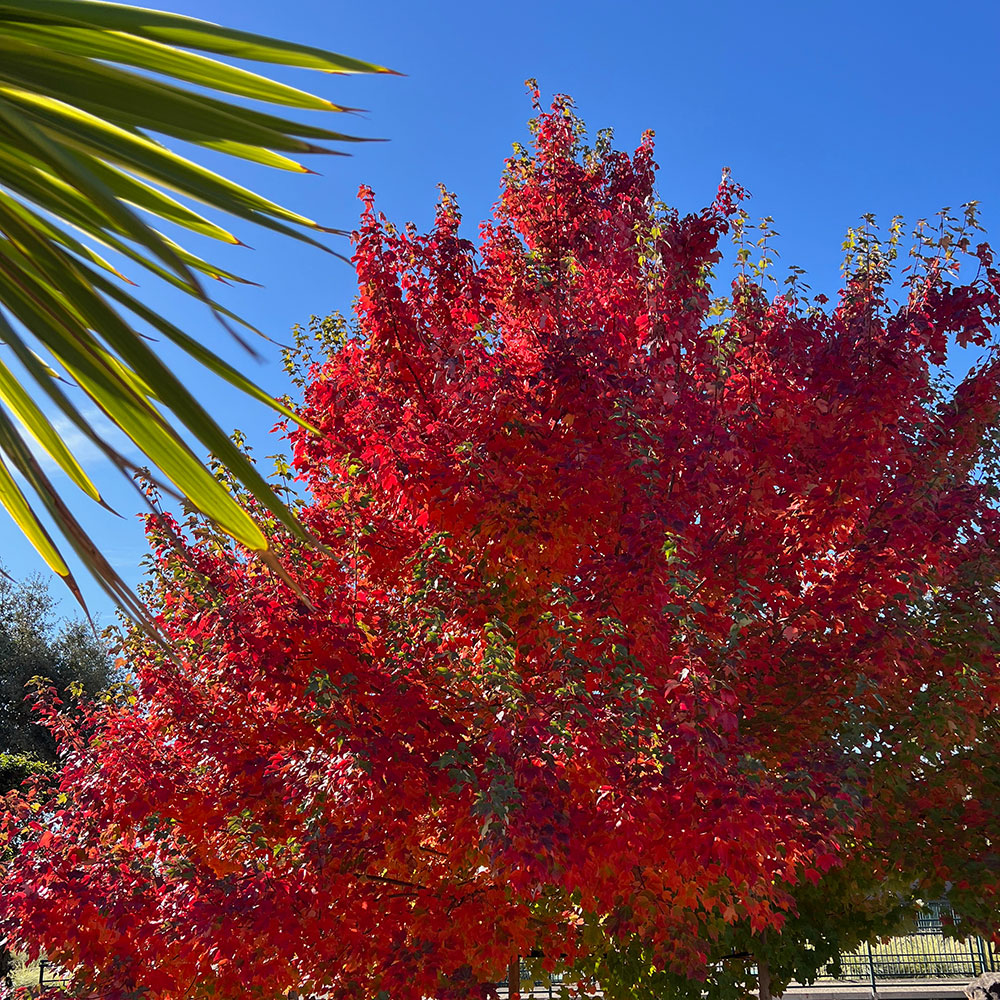
Everyone has a favorite place to see fall colors. Some find several locations to see them. Maybe it’s a single tree standing alone—showing off. Or maybe it’s a grove or line of planted trees sharing a palette of colors, like the yellow ginkgo trees in front of City Hall, or the oak trees along Vine Street, or the maples in BACA’s parking lot. This beauty is in Oliver’s parking, a striking contrast to the evergreen cactus nearby. Generally, one thinks of New England and woods in Vermont for fall color, but Sonoma County has an amazing variety of trees exhibiting spectacular color this time of year. One just needs to know where to look. Where’s your favorite tree or viewing place for fall colors?
FUN FACTS: When it comes to color, the leaves’ decision about “what to do next” is predetermined. When daylight wanes and temperatures drop, leaves stop converting CO2 and H2O to sugars and starch. It’s not so much that leaves turn colors, but that their green pigment diminishes to allow less dense colors to emerge. For instance, carotene—the same chemical that makes carrots orange—and xanthophylls begin to show.
These chemicals of orange and yellow are present all summer, but chlorophyll absorbs light in their spectrums causing green leaves to appear green all summer. Reds and browns occur from new chemicals, anthocyanins, not present in summer. Anthocyanins accumulate when the phloem pathway is blocked and sugars cannot exit. Leaf colors vary with the amounts of sugar trapped in each leaf.
Dry conditions with sunny days and cool nights produce the brightest colors. Sonoma’s fall has been quite cool and dry, producing amazing colors! Dull colors result from warm nights. Chlorophyll continues production with leaves staying green and then quickly turning brown. The acidity of trees affects color, too. Sumacs turn fiery red from high-acid sap. Other red-leaved trees include sugar and red maple, sassafras, and white and scarlet oak. Some oaks and ash can turn purplish because their sap is less acidic. Tannins, a waste product, cause browning. Tannins are the broken-down product of chlorophyll and carotenoids and the last color before leaves succumb to fall.
“Moonlight in Vermont” is an evocative song written in 1944 by Karl Suessdorf with John Blackburn. The lyrics bring to mind New England’s autumn: “… falling leaves of a sycamore, moonlight in Vermont …” The song was the traditional first song at Vermont weddings. It’s been sung by Sam Cooke, Sarah Vaughan, Jo Stafford, Willie Nelson, Billie Holiday, Frank Sinatra, Ella Fitzgerald and Louis Armstrong. The original 1944 version, released by Capitol Records, sold 2 million copies in two years.