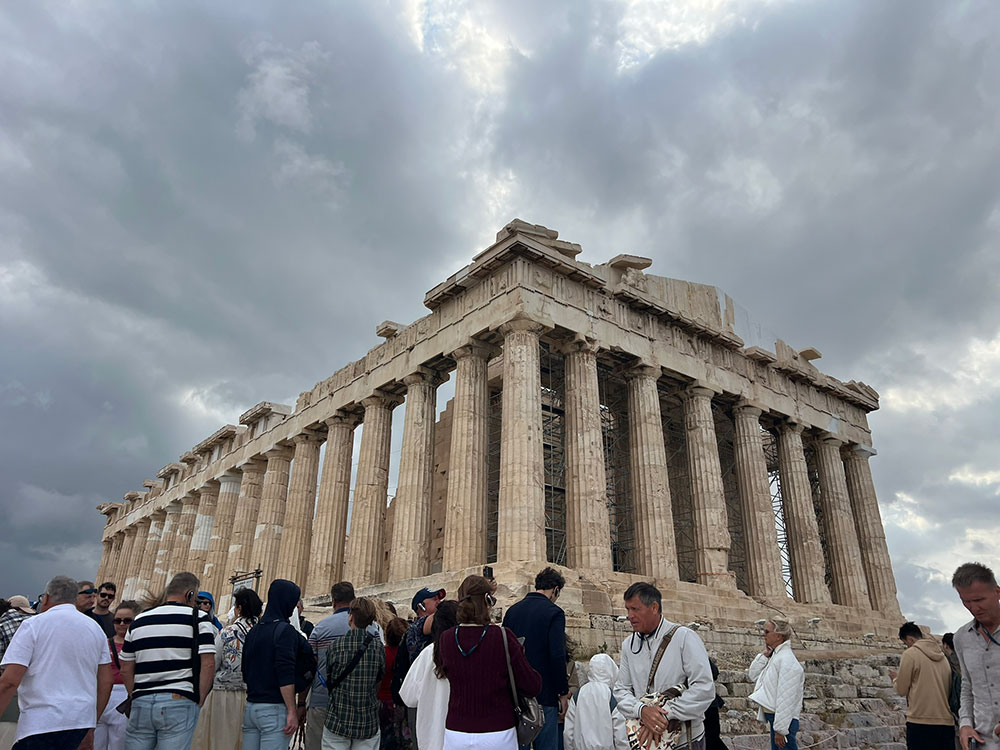
The Parthenon, high atop the Acropolis in Athens, was built around 440 B.C.E. Today, a storm blows in threatening dark clouds. Perhaps a metaphor for an AI apocalypse, a war of robot drones or America’s political parties claiming democracy ends here if the other wins a political election. Perhaps it’s just a cloudy day in Athens as the world turns, 2,466 years later.

FUN FACTS: Democracy appeared around 500 B.C.E. when Kleisthenes (or Cleisthenes), “Father of Athenian” democracy, with Spartan help, overthrew a tyrant ruler, Hippias. Hippias later returned with Persians to regain power. After the overthrow, wealthy clans and Spartan military leaders battled to rule. Kleisthenes was recalled by popular appeal to banish the Spartans and quell internecine conflicts. Kleisthenes delivered. He ended power struggles by organizing the country into 140 townships based on interests in coastal waters, urban centers, countryside farming and mountainous grazing. This broke hereditary, tribal clans’ (Greek: genos) power.
Townships’ citizens voted at public assemblies. Assemblies occurred 40 times per year. Six thousand people formed a quorum. Votes were by raised hands. Any citizen could speak. A council of 500, the Boule, met between assemblies to organize an agenda. Boule members were selected by random lots.
At that time, approximately 250,000-300,000 people inhabited Greece. About 10% were citizens; 30,000 men. Women were not citizens, slaves were not and foreigners—even multigenerational landowners and merchants—were not. Ostracism or banishment for up to 10 years policed corruption and accumulated power.
Athenian democracy solidified during the Persian wars, 500-450 B.C.E., when Hippias returned and citizen soldiers fought side-by-side with unknown neighbors rather than kin and clan leaders. The egalitarian fighting power of Hoplites to preserve freedom of assembly, speech and self-determination defeated a Persian superpower at the Battle of Marathon.
Around the same time, Greece developed a powerful navy. Triremes required massive rowing power. Oarsmen, lower-class citizens unable to afford Hoplite armor, triumphed in the Battle of Salamis in 480 B.C.E. Their victory brought prestige and a path upward in Greek society. Does any of this sound familiar to another country’s citizen-led beginnings?