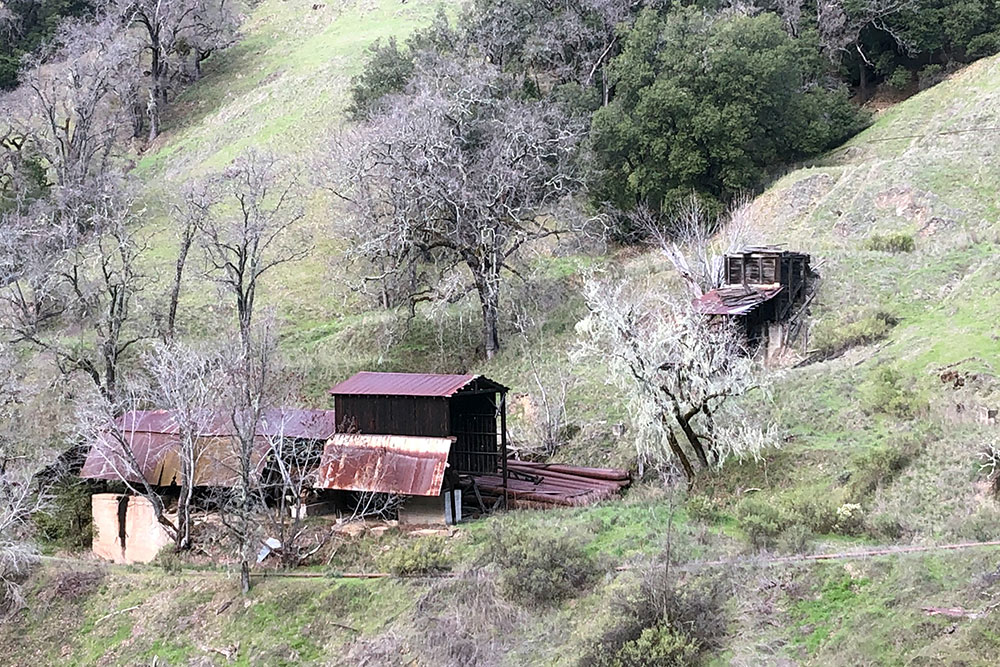
Back in the 1870s, Sonoma County experienced a quicksilver mining boom. Many mines, including this abandoned one, were established around Pine Flats Road. Remnants of some of these operations, like the one above, are still visible. Others appear more as holes dug out of the side of the mountain, with rubble descending down the slope making them easy to spot.
The quicksilver boom in Sonoma was short-lived, but long enough to establish the town of Pine Flat with three hotels, 60 houses, six saloons and services including bakeries, laundries and a lumber yard in 1873. Approximately 3,000 people lived in the area, which was touted as the fastest-growing town in Northern California.
Then, just as quickly, the boom ended. Mercury, which was used to extract gold and silver from Nevada’s Comstock Lode mines, crashed in 1875. By 1880, Pine Flat was a ghost town of boarded-up buildings and abandoned mines. The remnants are still there to be seen as environmental scars and contamination and/or a colorful chapter of local history.
FUN FACTS: Quicksilver, or mercury, is the only metal that appears in liquid form at room temperature. Listed 80th on the periodic table, its symbol is “Hg,” a combination of water and silver from the Latin hydrargyrum, liquid silver, and colloquially quicksilver. Its boiling point is 365 degrees Celcius. Its meniscus—the curved upper surface—is convex rather than concave like most liquids. It ranks 67th in minerals and by weight is 85 parts per billion of the earth’s crust, making it quite rare. It is also extremely toxic and approximately 14 times denser than water. Lead will float on it.
Mercury has been used since 5000 B.C.E., and pure mercury has been found in Egyptian tombs dating to 1500 B.C.E. Its usefulness in mining stems from its ability to chemically pull silver and gold from crushed rock. Amalgams formed around the liquid are easily rendered to pure gold and silver. Mercury itself is derived from cinnabar ore, which also produces red pigments. Though its toxicity has been known since ancient times, mercury had many applications including uses in felting furs for hats, resulting in the phrase “mad as a hatter.”
Alice in Wonderland was first published in 1865. Its author, Charles Dodgson, an Oxford mathematician and logician, wrote under the pseudonym Lewis Carroll. The story of Alice’s adventures was originally told to three small cats, including one named “Alice” on a Thames boating trip. The Mad Hatter in the story is derived from mercury’s neurological poisoning effects common amongst London’s hat makers.