A week before Christmas, the farmers’ market begins to exhale. The crates thin. The mornings turn darker. Rain settles in, and with it comes the quiet understanding that this season of gathering has reached its natural pause while the market prepares for its next chapter and its new home.
This is the time of year when cooking turns inward.
The tomatoes and peaches are long gone, but their memory lives on in jars lining the pantry shelves. Jams we jammed. Fruit we dried. Preserves sealed on warm afternoons that now feel impossibly far away. Winter cooking is less about what is freshly harvested and more about what was purposefully saved.
This is the season when the pantry becomes its own kind of market. Shelves fill the way stalls once did, each jar labeled in familiar handwriting, each bundle tied and tucked away for later. Tomato sauce waits for winter evenings. Plums and pears rest in syrup. Dried figs and apples reappear in cakes and holiday loaves. What was once abundance in the open air becomes abundance kept, drawn upon slowly as the days shorten.
In winter, a farmers’ market does not disappear. It simply moves indoors—reorganized, patient and deeply personal.
For me, Christmas lives inside a cake.

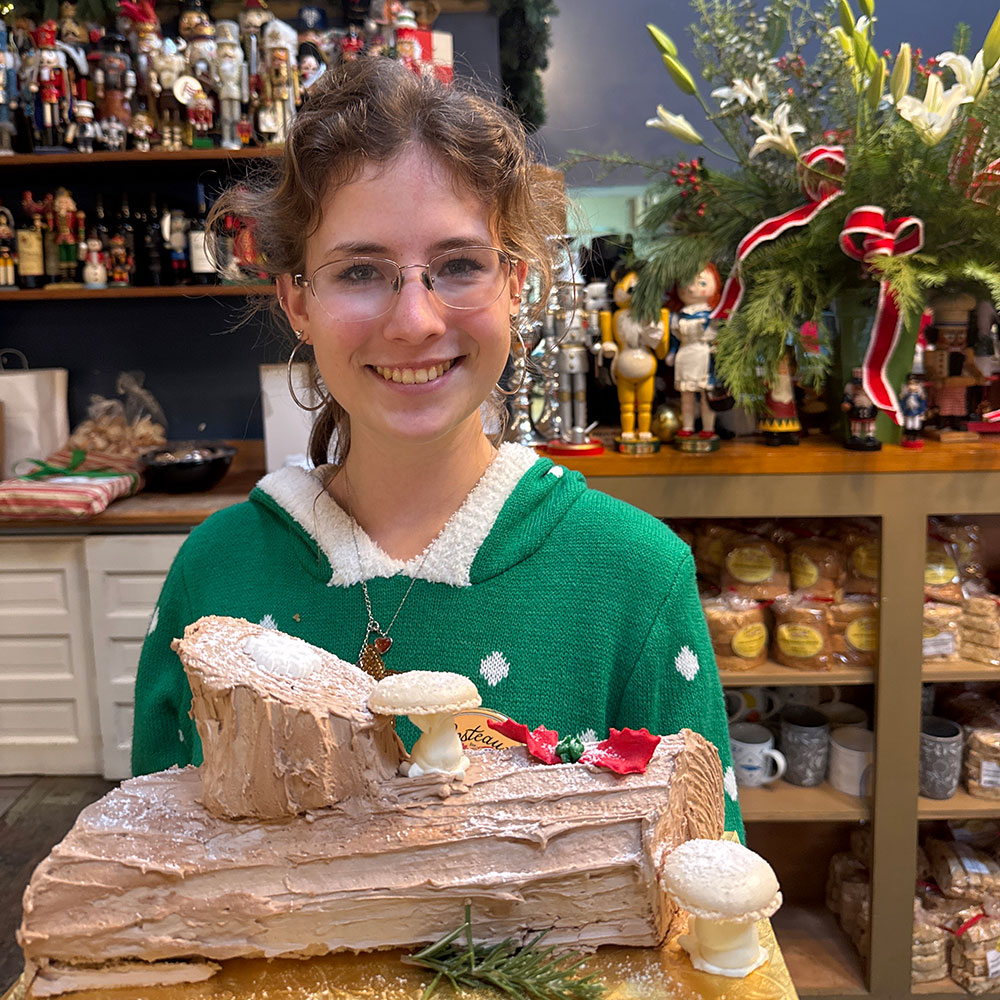
My family’s tradition is the bûche de Noël. A Christmas log. It arrives on an antique silver platter, dusted lightly with powdered sugar for snow, as if it has just been lifted from the forest floor. Marzipan mushrooms with hand-etched gills. Candied moss. A small forest bird perched nearby. It is precise and whimsical all at once, a dessert that belongs unmistakably to Christmas.
My mother is an artist, and she brings that sensibility into everything she makes. Cooking school gave her structure and fluency, but the artistry was already there. Her bûche de Noël is never casual. The marzipan mushrooms, the candied moss, the small forest bird: Each element feels placed rather than added, as if the cake were a landscape assembled by a master landscape painter.
The tradition itself dates back centuries. Before cakes were involved, families in parts of France burned a ceremonial Yule log in the hearth to bring good luck and warmth through the winter. Over time, as homes grew smaller and hearths disappeared, the ritual moved from the fire to the table. The log became a cake. The symbolism remained.
At its heart, a bûche de Noël is simple. A thin sponge cake is baked, rolled while warm, then filled and rolled again to resemble a log. In our holiday tradition, a delicious addition to the tried-and-true recipe is strawberry jam or raspberry preserves saved from summer, their brightness cutting through the richness of the cake. The outside is frosted and textured to look like bark. Everything beyond that is imagination.
Presentation has always been as important in our holiday celebrations as the dishes themselves. The table is treated as its own form of art: tartans drawn from our Scottish heritage, china from my great-grandmother’s collection and ornaments my mother spent years making by hand. Then there are the silver bells, engraved and given to me one each year, now so many that they cover an entire tree.
For anyone intimidated by the idea of making a bûche de Noël, there is no shame in starting simply. A pre-mixed cake base works beautifully. Use fresh eggs from a local farmer. Whip a basic frosting. Roll gently. Frost generously. If marzipan mushrooms feel like too much, a dusting of powdered sugar or cocoa can be just as elegant. The key is using as many farm-fresh ingredients as possible, and adding in a layer of summer jam or preserve is a delicious way to bring one’s tastebuds to joyful moments of summer.
The farmers may be stepping back for the season, but their presence remains in every pantry shelf and every holiday table. In the eggs. In the flour. In the jars opened slowly and deliberately as the rain falls outside.
As this year draws to a close, I am deeply grateful for the farmers, makers, readers and neighbors who have supported this column and the work behind it. Wishing you a warm and generous holiday season filled with good food, shared tables and the quiet pleasures of winter.
‘Farm + Market: Healdsburg’ will be released in spring 2026, and it exists because of this community. Order at healdsburgbook.com.