In July, 75 percent of voters in Sonoma and Marin Counties voted to extend SMART’s sales tax. Many of us did so hoping the train would get people out of their cars, a key SMART goal. In December, the SMART board will decide where Healdsburg’s station goes, and that choice will decide whether the train does what we voted for. The Vine Street site is the clear choice.
Healdsburg is a destination town. More people come here each day than leave. Over 5,000 people commute in to work, most of them in or near downtown. On weekends, neighbors and visitors come to enjoy the Plaza. This is where riders want to go, and today, nearly all of them drive to get there.
Whether they choose the train instead depends mainly on how far they will have to walk after they get off. Transit research here and in Europe finds this consistently, and SMART’s own analysis agrees. The Vine Street site is about 620 feet from the Plaza in the town center, a two-minute walk on clearly marked, lighted and signaled streets. The Depot is nearly 10 minutes away on neighborhood streets and sidewalks.
Supporters of the Depot site have raised real concerns about Vine Street, and deserve more than assurances. If the board chooses Vine Street, SMART and city officials should make written, funded commitments as part of that decision. These should cover safety and congestion at the Healdsburg Avenue Roundabout.
Vine Street serves the town that Healdsburg is today and will be for decades, and it will take more cars off our streets than the Depot site. I urge the SMART board to make the right choice for Healdsburg and for everyone SMART serves.
David Lawrence, MD
Healdsburg
While one can make a case for both the old Depot and a Vine St. train station location, on balance I support leaving the station at the old Depot site.
The train station located at the old Depot was the foundation of the Central Healdsburg Avenue Plan (CHAP). It included up-zoned land uses around the Depot and street type designations with specific design guidelines that are now embedded within our Zoning and General Plan. Moving the station would render the CHAP seriously out of whack. Will the CHAP, our General Plan, zoning and design guidelines be reconsidered and revised if the station moves?
The City is embarking on a plan for the south side of the bridge. It is also based on the historic station location. Hopefully there will be significant housing in this area. The Depot site is midway between this area and downtown. A Vine St. station would be over a mile walk from south of the bridge. It would be short sighted to ignore the area south of the bridge.
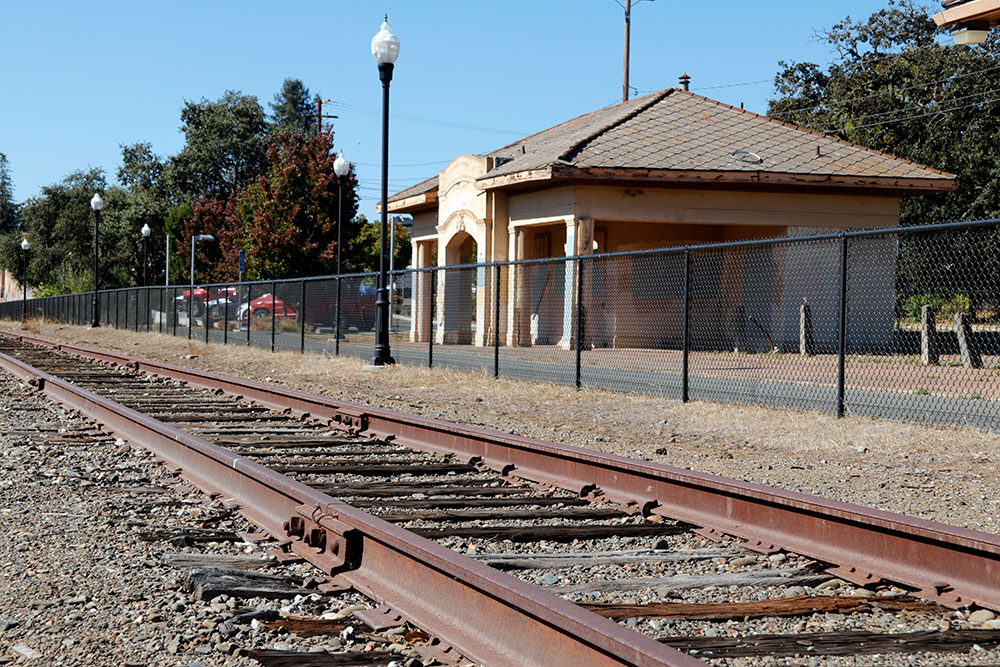
The station at the Depot will provide incentive for the historic Depot building to be refurbished and put to use (coffee shop? toilet rooms?). Having legitimate use is key to successful building restoration. Getting off at the historic Depot site with a refurbished Depot would connect visitors and residents alike with our long history of train service and its impact on Healdsburg.
The station at the Depot will bring ridership closer to the redeveloping area south of the roundabout.
While a Vine St. station will deliver people closer to the downtown, the old Depot site is +/-2000 ft. to the Plaza via the bike/ pedestrian walk. Per Google AI that takes 7-8 min to walk at a normal pace, 6.5 min at a brisk pace, 9 min. at a leisurely pace. I don’t think a 7–8-minute walk to the Plaza will discourage employees or visitors from coming to Healdsburg.
A parking lot was built next to the Depot for the future station. Do we want to add more southbound commuter cars parked all day downtown?
And finally, while it could be that inbound passengers, both visitors and commuters, will be greater than outbound passengers as SMART staff claims, they have not demonstrated this. Their recent biased presentation to the City Council included diagrams that ignored everything south of the tracks where many lower income residents (who are likely to commute to points south) live. They seem to ignore any potential housing south of the bridge.
SMART staff’s presentation, their shift from ‘this is a Healdsburg decision’ to ‘it’s a SMART’s decision’, and their claim that they did not have adequate feedback after the extensive public input during the 2024 City Council revisit leaves them with little credibility. We should be thinking about the future, not just current conditions and while SMART may only think about ridership numbers, we in Healdsburg have broader concerns. Healdsburg should be able to determine where the station is, not SMART.
Alan B. Cohen
Healdsburg
I have lived just outside city limits for over 40 years, so I feel very much a local even though I cannot vote in city elections. I am writing with respect to the proposed location of the SMART station in Healdsburg.
First, it’s clear that SMART has to generate revenue to be viable, so their Board has a duty to make decisions that will maximize ridership and revenue. Our input is welcome, but the ultimate decision must be theirs, not ours.
In thinking through our position as a community then, it’s important to prioritize what really matters. From what I’ve read and heard, the biggest issue for most people seems to be parking, especially downtown.
If so, a pretty simple question emerges: Are more people originating their trip outside Healdsburg (i.e. are non-residents, meaning tourists and people who work in town but live elsewhere), or are they Healdsburg-area residents going elsewhere?
If local residents originate the majority of trips, that would make a strong case for putting the station on Hudson Street, in order to minimize the number of cars parked in town.
If, on the other hand, non-residents coming to Healdsburg are responsible for the majority of trips, then putting the station on Vine Street would make the most sense, because the train would drop them near their workplace or the tourist attractions, thereby encouraging them to use the train and leave their cars behind.
My gut, based solely on anecdotal observation, is that the majority of trips originate elsewhere—I’m told that over 5,000 people come here for work each day; most of whom work in town. But I’m sure the City and SMART can supply hard data.
Either way, it behooves us all to let the data drive the right decision; the whole town will live with the consequences for decades to come.
Ridgely Evers,
Sonoma County