

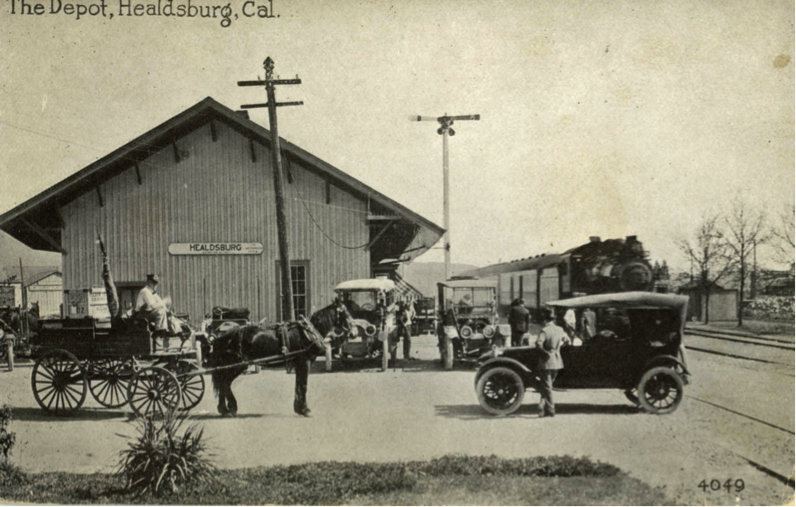
The City of Healdsburg has begun planning for the eventual arrival of SMART, perhaps as soon as the end of 2028. The planning began at Monday’s City Council meeting, when the five-member board heard from Planning Director Scott Duiven about the formation of a Healdsburg Station Area Specific Plan and the formation of two Community Advisory Committees to contribute to the process.
The project is funded by a $1.13 million grant from the Metropolitan Transportation Commission through its Transit-Oriented Communities (TOC) program. The program encourages cities to concentrate housing, jobs and services near public transit so people can get around more easily without relying on cars.
While Healdsburg’s recently adopted Housing Element positions the city well to meet TOC requirements related to affordable housing production, preservation and protection, preparation of a Specific Plan is necessary to address TOC requirements related to minimum residential and commercial office densities, parking management, and station access and circulation.
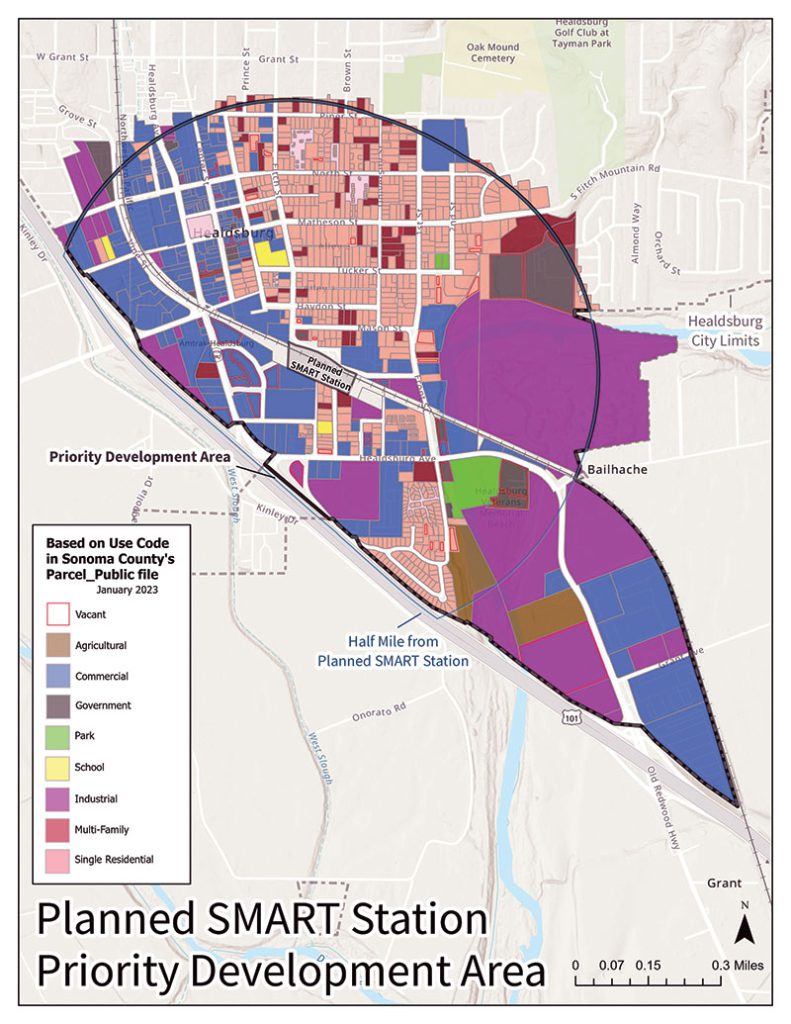
The Specific Plan will also integrate land use, housing, employment, transportation and infrastructure planning for the South Entry Area, which currently lacks public utilities, including water, sewer and stormwater infrastructure. The planning area is specifically defined by a half-mile radius from the planned SMART station, but that includes almost all of downtown and extends into the South Entry area on the far side of Memorial bridge.
The plan is also designed to help Healdsburg stay competitive for future regional transportation and housing funding, including One Bay Area Grants.
Following execution of the funding agreement, the City issued a Request for Proposals (RFP) to retain a qualified consultant team to assist with preparation of the Specific Plan. The RFP was released on Jan. 6 of this year, with proposals due Feb. 20. In his presentation to the council, Duiven anticipated completing proposal review and selecting a consultant by the end of March, with City Council consideration of a contract award tentatively scheduled for April 6.
Upon contract execution, work on the Specific Plan will begin and continue for about three years. Grant funds must be expended by June 30, 2029, which may or may not be simultaneous with the arrival of SMART service to Healdsburg.
Duiven emphasized that robust community engagement will be essential to the success of the planning effort. Outreach will seek participation from residents of all income levels, races and ethnic backgrounds; employees of local businesses; community- and faith-based organizations; and public agencies providing services in the plan area.
Two advisory committees will be established to support plan development: a Technical Advisory Committee (TAC) to provide technical expertise and review plan materials for accuracy and feasibility; and a Community Advisory Committee (CAC) that will provide community input throughout the planning process.
Membership may include residents, property owners and business owners within the plan area; representatives of the development community; members of local organizations; and residents and business owners from outside the plan area.
While the usual method of selecting commission or committee members is to have a two-person subcommittee of the council evaluate applications, it eventually decided to focus on selection of the CAC, leaving the appointment of the more specialized TAC to the planning director.
In fact, the council spent much of its time on the issue of selecting the members of the CAC, the community advisory committee, and how many should be on it. Numbers from 7 (too small) to 40 (too large) were discussed before it landed on 15 members (just right!).
“We could go higher or lower depending on the applicants we decided,” said Mayor Chris Herrod. “But at 15, it made sense; there’s so many types of people that we wanted to have in the group representing different viewpoints and backgrounds.”
Still, given the difficulty in getting qualified applicants for such city bodies as the Planning Commission and Parks and Recreation, the expectation that the council will even be faced with an excess of applicants seems questionable. “Anybody who applies is an angel, right?” said Herrod. “We’re super grateful for anyone who raises their hand.”
Vice Mayor Ron Edwards several times emphasized making selections with an eye toward the future, meaning including more young residents, for whom the future of Healdsburg is their future, not their legacy.
While the exact timeline of the committee selections is not set in stone, Herrod thought the next step would be for Duiven to present an application to the council for its final input, then an active distribution process to recruit members. He did not anticipate any problem in getting applications.
“This is a short-term thing, this is juicier,” he said. “It’s very hands-on, it’s project-oriented.”
At the end of the discussion, when asked if he had enough input from the City Council to proceed with his plans, Duiven said, “I feel like we have plenty. And I also just want to note that this conversation really helps reflect the magnitude of this process, the importance and the opportunity that’s before this city. I appreciate your diving into this.”
He continued, “It is a little bit daunting. I admit, but it’s a great opportunity for this community to look at its future.”






I am very excite.d to see SMART TRAIN coming to HBG – as a 2yr new resident to the RiverSide community it will bring a transportation option. I like the idea of refurbishing the old Train Station and hope that will continue in the plan.
I’m so glad that you shared this story!