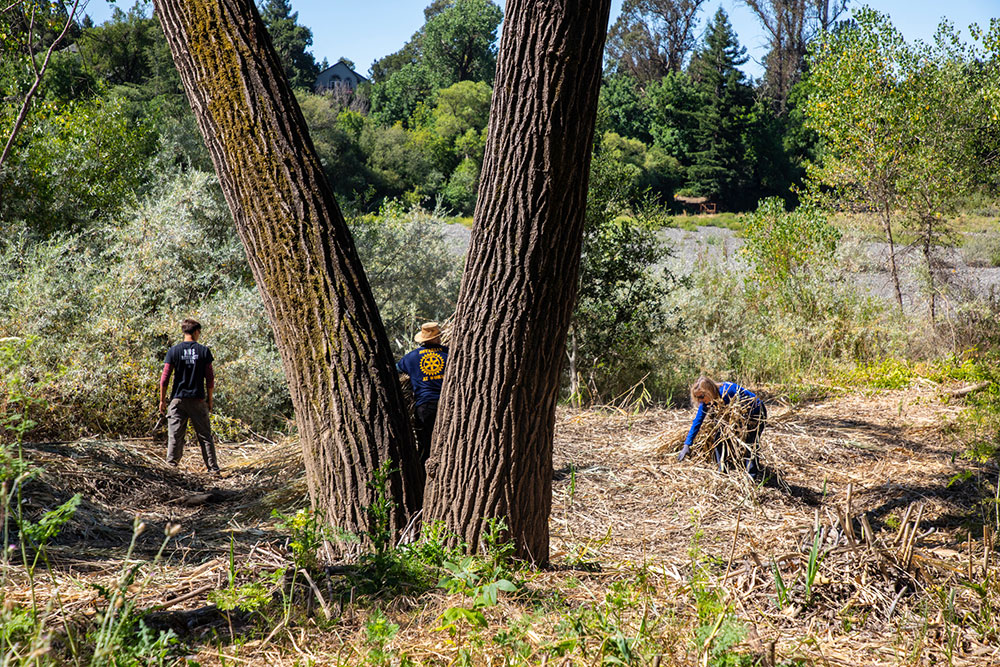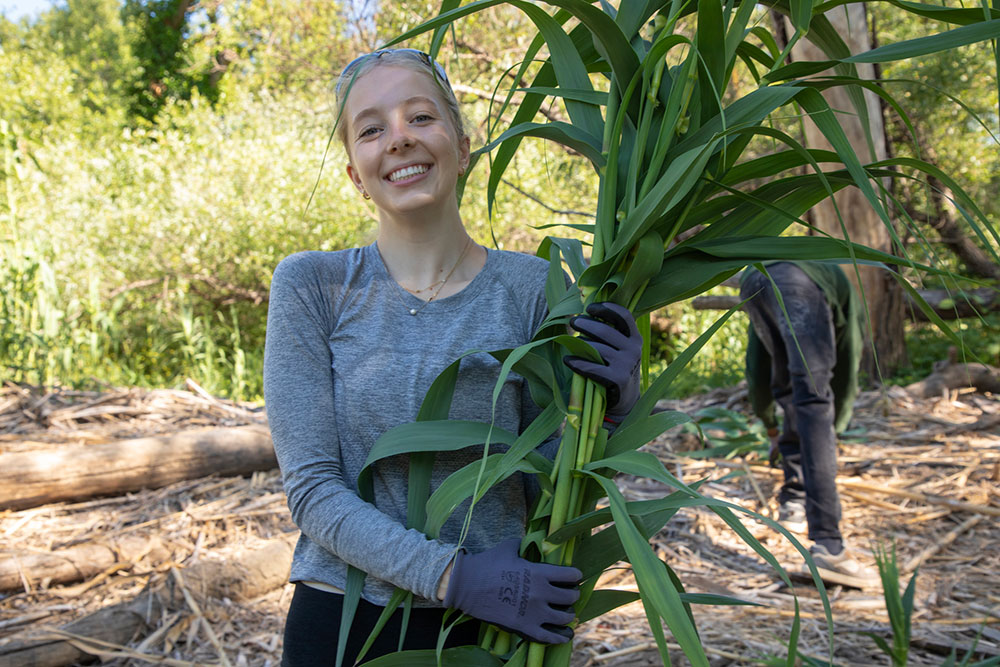
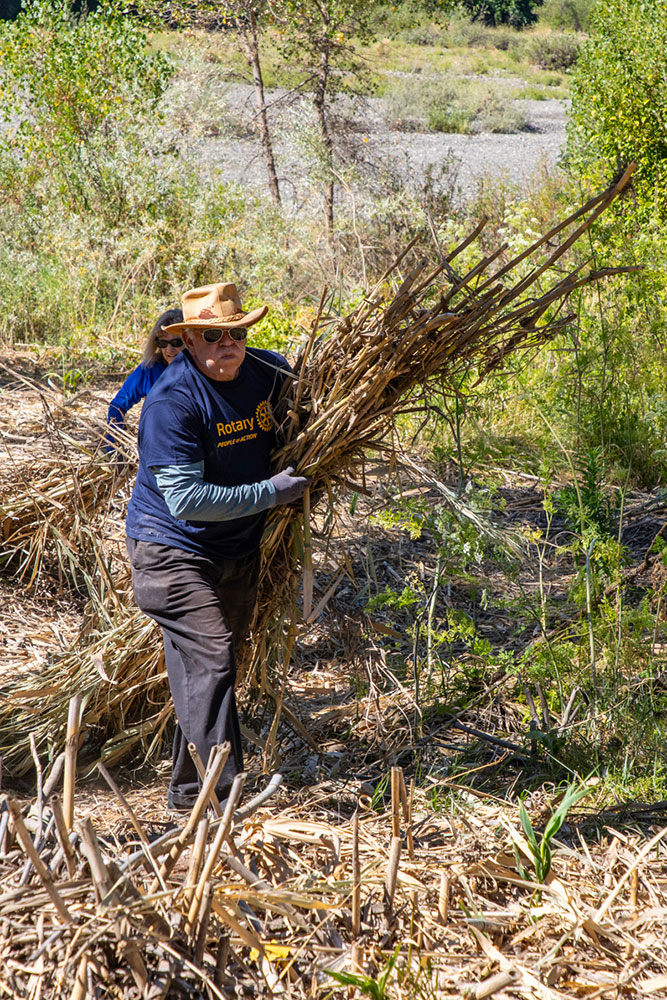
It looks like a tableau from Diego Rivera, the long-sleeved workers sweating and hunched beneath great swaths of reeds—only it’s not sugar cane but Arundo donax. Known variously as giant cane, elephant grass or Colorado River weed, the giant reed grows up to 30 feet in height and is widespread though much of the temperate world including the American Southwest. Considered invasive in the United States, local Rotarians are out to control it.
One can’t miss it on any visit to the Russian River around Memorial Beach. It may look like slender bamboo, but it’s fast-spreading and highly flammable. It’s also very thirsty, using “50% more water from the Russian River compared to the native riparian flora,” Norm Fujita told us.
He and his fellow club members from Rotary Noon started work on extirpating the invasive reed after Russian Riverkeeper received a grant from the Coastal Conservancy to remove it. The grant, which originated after the fires of 2017 and 2019, was encouraged by environmentalists and fire safety experts to target Arundo because it is very flammable when it becomes dry.
“Arundo consumes up to 7 million gallons per acre which we need to keep in our river,” said Russian Riverkeeper’s Don McEnhill. “Arundo also displaces critical native plants and trees along the Russian River. No trees means no birds and a significant loss of biodiversity.”
Fujita, the Rotary Noon environmental director since 2021, said Russian Riverkeeper got involved with the removal of Arundo about a year before the club decided to assist. Fujita said, “Our Rotary Club obtained a Rotary district grant to purchase equipment for the Russian Riverkeeper and helped it cut down Arundo.” Their project was part of the city’s larger Climate Mobilization Strategy.
The task is to remove the plant as completely as possible. Long sleeves, gloves and machetes are essential. It may seem like a thankless task at first, but it is ultimately rewarding in the way only volunteerism can be.
It didn’t take long for the Healdsburg Rotary Sunrise Club and Healdsburg High School Interact Club to join in the effort in about 2022. “In 2023, I suggested that this project could be scaled up to have other Rotary Clubs within our Rotary district to help with this work,” Fujita said. “Under the leadership of the district Rotary environment committee chair, Barbara McChesney, it was transformed into a district project.”
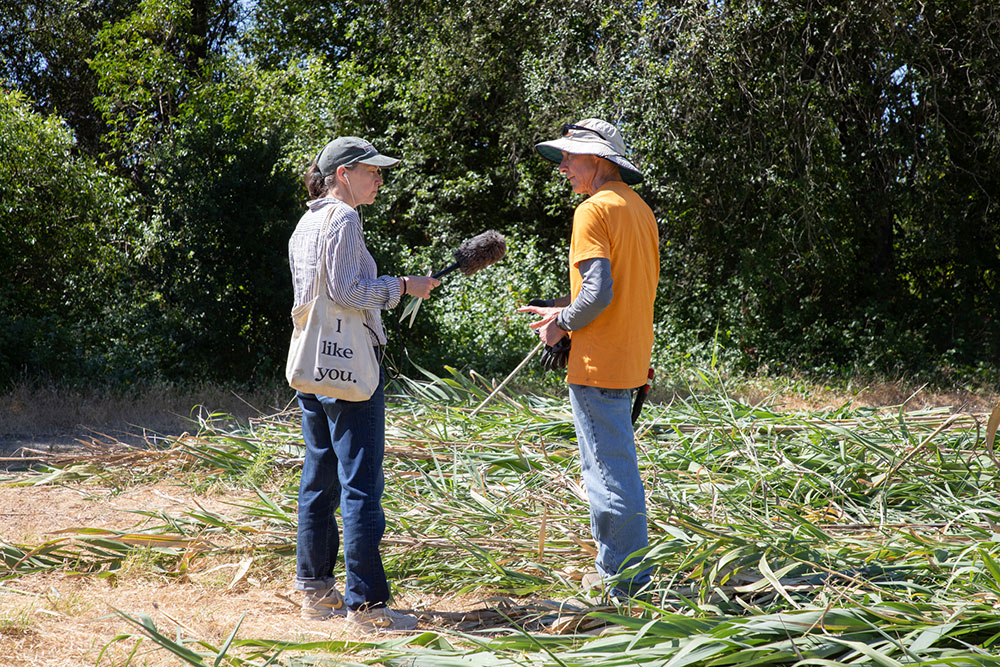
Groups of up to 50 volunteers from as many as 11 Rotary Clubs and four Interact Clubs (high school student groups supported by a local Rotary) have joined in the efforts during the past three years, and news of the project has spread, or perhaps grown organically might be a better term. They meet in the morning, share water and snacks, and often collect for a shared lunch. It’s social environmentalism.
Eventually, editors at Rotary International Magazine decided to commission a story on the local Arundo removal project and contacted freelance journalist Mary Catherine O’Connor—known for her environmental reportage—to write it. Her assignment came in just after the May 9 regular workday, so another workday was held on Saturday, June 13, to accommodate O’Connor’s request to see the project in action.
So around 8am that Saturday morning, 31 volunteers from at least five local Rotary Clubs and two Interact Clubs showed up to do what they do: work together to make a difference.