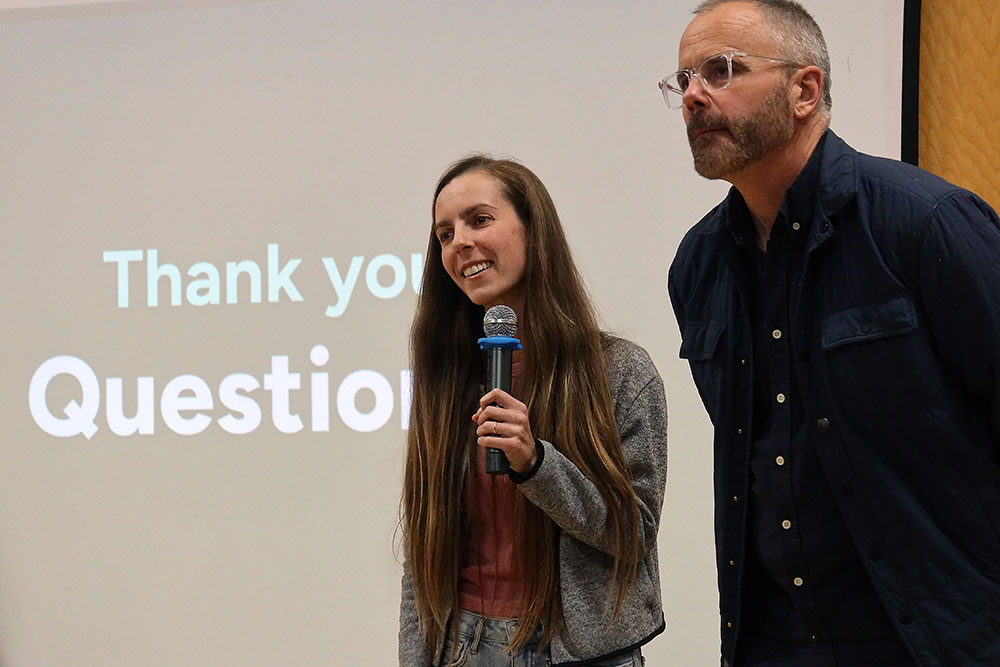
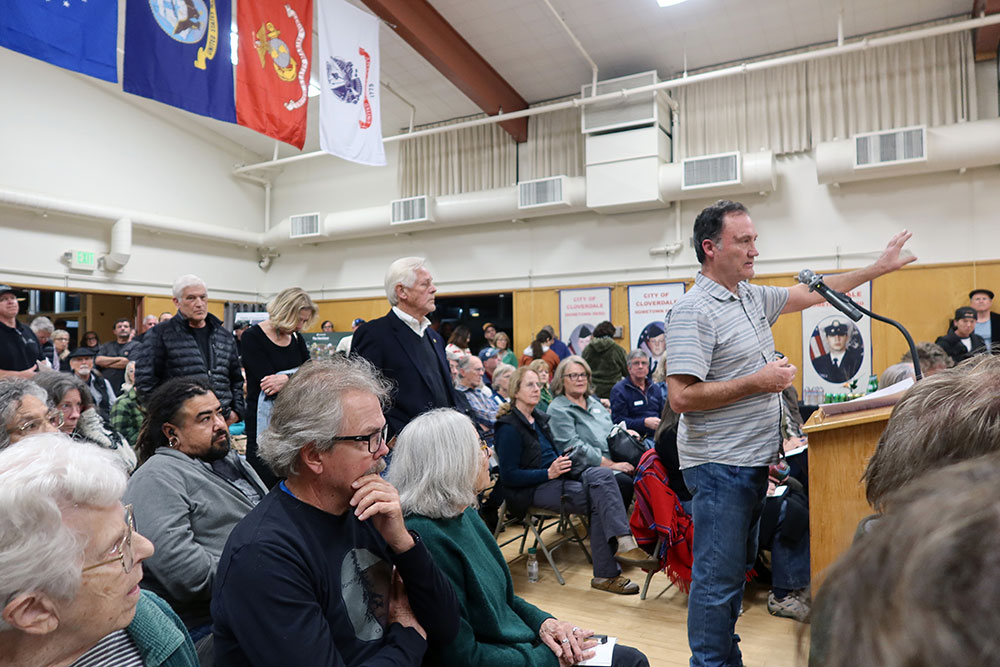
Devon Zuegel, founder and president of Esmeralda Land Company, and Michael Yarne, its director of development, stood before an often skeptical audience of close to 300 at the Cloverdale Veterans Memorial Building on Feb. 5 to explain, and defend once again, their ambitious plans for a “Chautauqua of the West” on former logging, Masonite and gravel mining property in Cloverdale.
The community’s skepticism is less about the planned housing development itself as it is about the context Zuegel has been making for the project for three years, and her connection to nontraditional followers of such social trends as the “Nation States” movement, artificial intelligence and cryptocurrency. Those objections, while outside of a city planning department’s purview, have become part of the conversation largely due to Zuegel’s own efforts to pre-market the concept through the annual Edge Esmeralda conference in Healdsburg.
“In parallel to planning the permanent physical development, we’ve been testing the concept through Edge Esmeralda, a month-long “pop-up village” that draws 1,000+ attendees each summer,” Zuegel told the Tribune. “It functions kind of like a college campus, where participants self-organize workshops and activities in addition to the primary planned events.”
But the connection with the Edge global series of “pop-up villages” (edgecity.live) split the crowd along predictable lines: rural vs. urban, old vs. young, traditional vs. innovative. Hence, smart talk about “high-agency people” and “society incubators” did little to sway anyone already pre-conditioned to disagree.
Still, the purpose of the meeting—to further inform the residents of Cloverdale about the scope and viability of the Esmeralda development—was largely met. Following their introduction by Mayor Brian Wheeler, the pair traded microphone and digital clicker to advance through their presentation for almost an hour. Zuegel has been making the rounds in Cloverdale’s government and business circles for three years to develop a community on the available 266 acres inside the city’s southeast quadrant.
The property, once the site of a sawmill, Masonite facility, gravel mine and truck repair shop, was approved by the City of Cloverdale for the Alexander Valley Resort over 20 years ago, but that project, complete with a private 18-hole golf course, never went into development.
Though Zuegel and Yarne did expand on the possible contamination of the site from its previous uses, they quoted the State Water Board’s recent judgment that, “The site has been fully assessed and remediated to the extent practicable, and current site conditions pose little risk to human health or the environment.”
But they had to acknowledge a not-insignificant parallelogram near the hotel area, roughly 9% of the overall acreage, that could not be developed, pending further testing and soil remediation.
Visioning
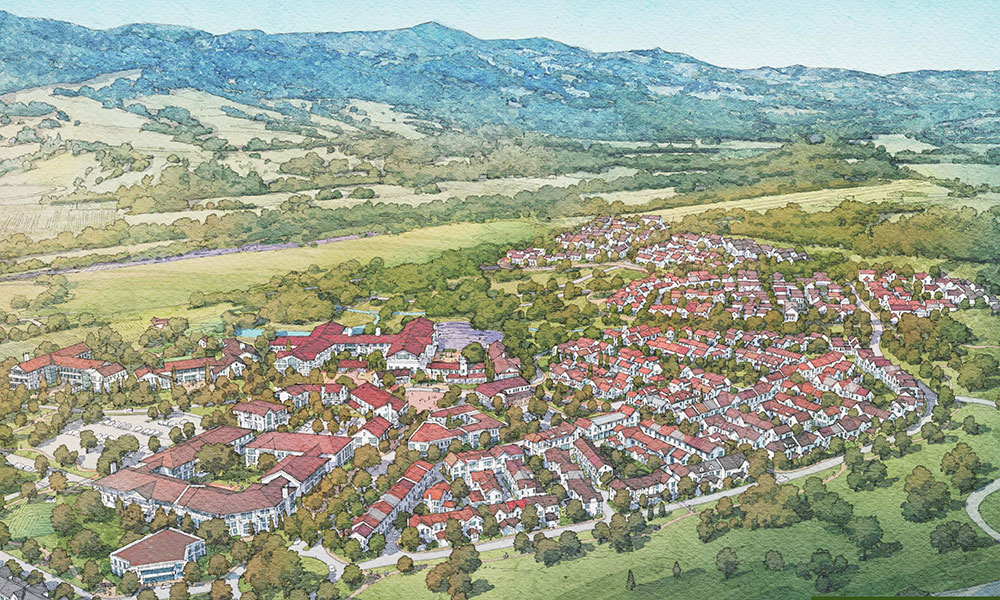
Zuegel’s vision for the property is a new housing development of up to 600 residences—single-family dwellings, multigenerational homes and even ADUs (accessory dwelling units). No golf course. There would also be room for a large hotel, some retail and office space, an outdoor amphitheater and possibly a school, depending on the city’s direction. All of which were presented in terms of their positive impact on the City of Cloverdale, including everything from tax revenue to utility support and pedestrian advantages.
The pair also took the attendees on a visual “tour” of the speculative development with a series of projections and maps, including what they called a “Necklace Trail” that would eventually link Esmeralda with the main city, and the trail-to-rail Great Redwood Trail that would pierce the 266 acres.
SMART would be routed through the property too, to end its eventual northerly run at the long-vacant Cloverdale depot, a long overdue linkage of the city to the rest of the Bay Area.
Yarne seemed to relish listing the many steps in the development process before any construction begins: a Master Grading Permit, Phased Development Review and Building Permit Review, each including opportunities for public input and city approval. This lengthy list led him to vow, “No earth will be moved, period,” for at least 18 months.
The pair readily acknowledged that the first part of the project will be the 125 to 200 hotel “keys” (rooms or suites) on the site, as it would help provide revenue for the rest of the village development. The hotel would not be a single edifice, but a series of small buildings that spread out around a central public area where retail could also appear.
Chautauqua
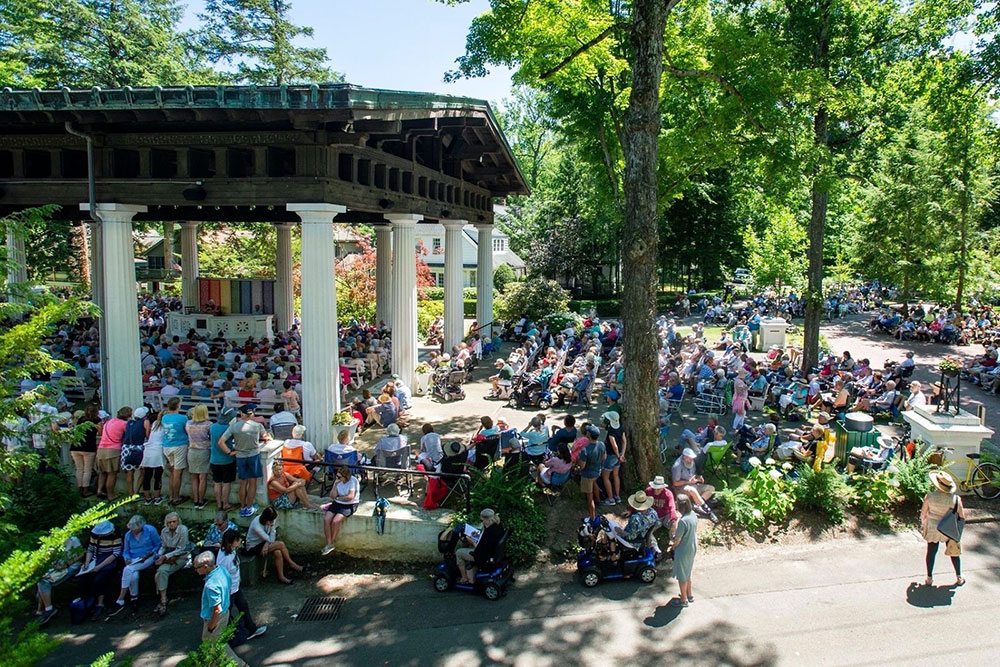
Zuegel often referred to the inspiration she drew from the Chautauqua community of western New York, where her grandmother lived and she visited as a child. The town today only has 4,000 permanent residents, but the Chautauqua Institute can draw over 7,000 visitors a day in the summer season, 100,000 a year. Illustrious social, artists and literary figures often appear at the Institute to this day.
During the Covid pandemic, Zuegel retreated to Chautauqua to wait out the shutdown, according to Business Insider. That renewed her interest in alternative communities, leading to the development of the Esmeralda concept, which includes an amphitheater designed for public lectures and other events, leasable to whomever wishes to hold an event, concert or conversation. Yarne and Zeugel pointed to it as a potential source of revenue for the Esmeralda village itself, during their Thursday evening presentation.
Still, Zuegel’s repeated references to it during the presentation prompted one of the locals to explode, “Where the hell is Chatonka? New York? You are not in New York, you’re in Cloverdale, California!”
Overall, many in the hall seemed to feel that the city and business community was behind it already, and that opposition would be of little use. More than one referred, knowingly or otherwise, to the prediction in the baseball film Field of Dreams, where a mysterious voice tells Kevin Costner, “If you build it, they will come.”
More online at esmeralda.org.