

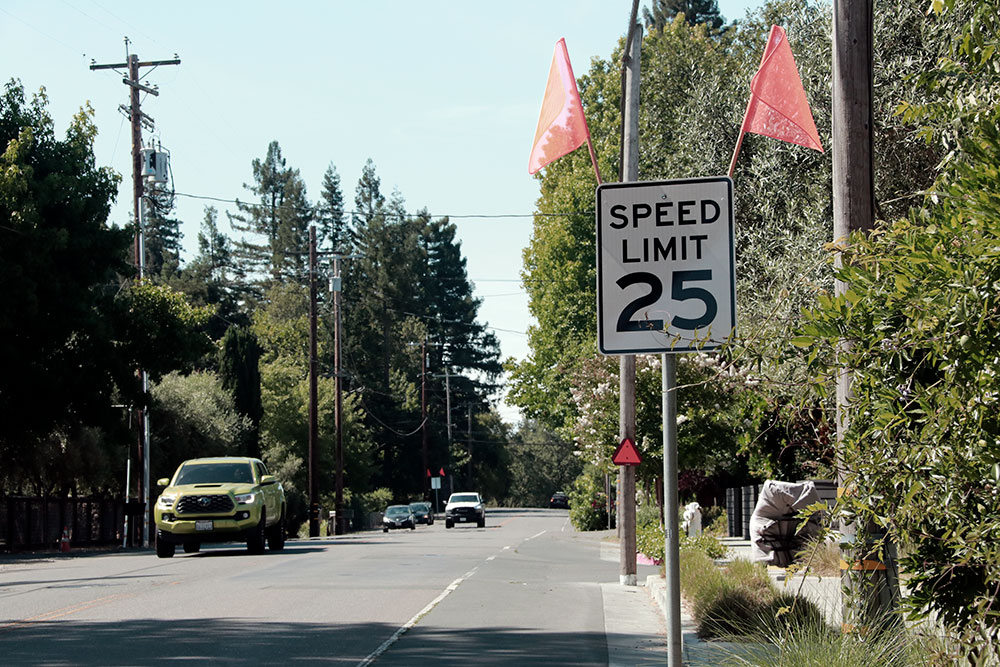
Speed limits: Against
Are the new traffic-calming speed limits worth it?
I have lived and worked in Healdsburg since 1982 and believe the recent reduction in speed limits are trying to solve problems that don’t exist and there are more negative consequences than positive. Reducing limits by 5 mph in the affected areas may increase annual driving time in the range of 20,000 hours spent in cars each year, which increases the likelihood of more speed violations, accidents, wasted gas, wear-and-tear on vehicles, and people’s time.
Because each car is on the road longer this will increase traffic congestion accordingly, especially during peak hours. Longer times in the vehicle will increase driver anxieties and related behavior. The roads in these areas are relatively straight and wide. There is not a speeding problem as evidenced by the lack of traffic violations, and the earlier speed limits are more in line with the road conditions. There wasn’t a problem that needed fixing, especially given the significant negative effects noted above. The estimates here are based upon 6,000 one-way trips per day for an average of three minutes before the reduction. Please reconsider the reduced speed limits; they don’t make sense to a lot of drivers and are not being followed very closely after the new signage with flags were installed.
Jim Brush, North Street
Speed limits: For
Did you know that vehicle speed is the primary determinant of survival in pedestrian and cyclist collisions, dictating both crash risk and injury severity? According to the AAA Foundation for Traffic Safety, the average risk of pedestrian death reaches 10% at 23 mph, 25% at 32 mph, 50% at 42 mph and 90% at 58 mph.
The difference between driving 32 mph versus 42 mph doubles the likelihood of someone dying when getting hit by a car while walking or biking.
I want our residents to be as safe as possible when walking and biking in town. Once we were presented with this data and the overall Vision Zero data for Sonoma County, which talks about the rising number of pedestrian and bicyclist strikes happening in our local communities, we all felt a duty to take action.
We were presented with a staff recommendation to increase speeds on streets in the community a couple of years ago, and many of us were perplexed as to why we would want cars going faster in places where new housing was being built, such as Chiquita near Grove. Unfortunately, state law prevented us from looking at roadway speeds on a case-by-case basis and the rules were archaic. We had no ability to dictate the speeds on our local streets.
Sadly many communities across the state and country were seeing a rise in these fatalities and severe injuries, and there was increased attention on how to prevent it. Our state legislature took the steps to change the state laws that mandates increasing the roadway speeds, and it gave us the local control to decide what speeds made the most sense for Healdsburg.
Healdsburg is lucky to be able to have slow streets for our neighbors to walk and bike safely, while also having the highway nearby for those in a hurry traveling from north to south. I know change can be tough, but at the same time, you only get one life.
Ariel Kelley, Councilmember
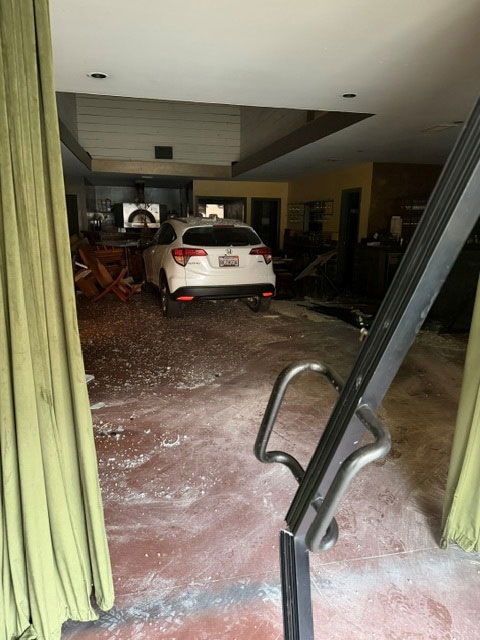
JUST STOPPING BY A white Honda made it past the entry foyer of Baci Cafe & Wine Bar, into the dining room and all the way to the pizza oven before stopping early on May 23.
On cars vs. buildings
The cars are hungry, and they refuse to wait for a table.
In the past month, cars (or more accurately, their drivers) crashed into a restaurant storefront near 8am and an outdoor parklet at 9:30pm, the latter with people inside having dinner. Both of these acts of traffic violence happened in the heart of downtown Healdsburg and as egregious as they are, they were not extraordinary.
At a recent picnic celebrating the end of the school year, some other elementary school moms and I exchanged crazy stories of encounters on our own neighborhood streets from near-misses to actual crashes into a pedestrian crosswalk sign and local businesses including a winery and a music store. I used to take comfort in the fact that we are raising children in a safe town. But now it feels like there is no place in town that is safe to be a pedestrian or cyclist, and there is no safe hour of the day.
When drivers are crashing into buildings at regular intervals I have to wonder what accounts for this disregard of expected behavior. After all, isn’t the sidewalk the one place where people can ambulate at a safe distance from vehicles? One reason is obvious: Drivers have more opportunities to be distracted than ever before. Another is by design: Our streets are made to prioritize vehicles over pedestrians. This is evidenced by the emphasis on parking spaces over bike lanes, the missing sidewalks and the wide streets that encourage speeding.
The pedestrian improvements identified in the recent active transportation plan would be a good start, but unfortunately there isn’t enough community support to make sure the updates get budgeted and installed. Other cities in Sonoma County, like Santa Rosa and Petaluma, have robust safe streets initiatives that show their governments prioritizes people over vehicles. When will Healdsburg catch up and start prioritizing us, too?
Stephanie Turk, Healdsburg
Send Letters to the Editor to ch*******@*****ys.com.



This is just another example of the city council solving a problem which doesn’t exist. Much like when Ariel Kelley pushed for spending tens of thousands of dollars for the removal of bollards on our paths after one cyclist died in Sebastopol, she has now promoted the lowering of speed limits in our city where there has not been a fatality in over five years. The speed limits were not the problem. The problem is people not following the posted speed limit or driving drunk. This was the council virtue signaling while making the lives of residents more inconvenient.