Active work begins March 30 on the nine-mile, Windsor-to-Healdsburg extension of the Sonoma-Marin Area Rail Transit line, when a series of core samples will be bored to evaluate the substructure of the route and let road-builders know what lies beneath the surface.
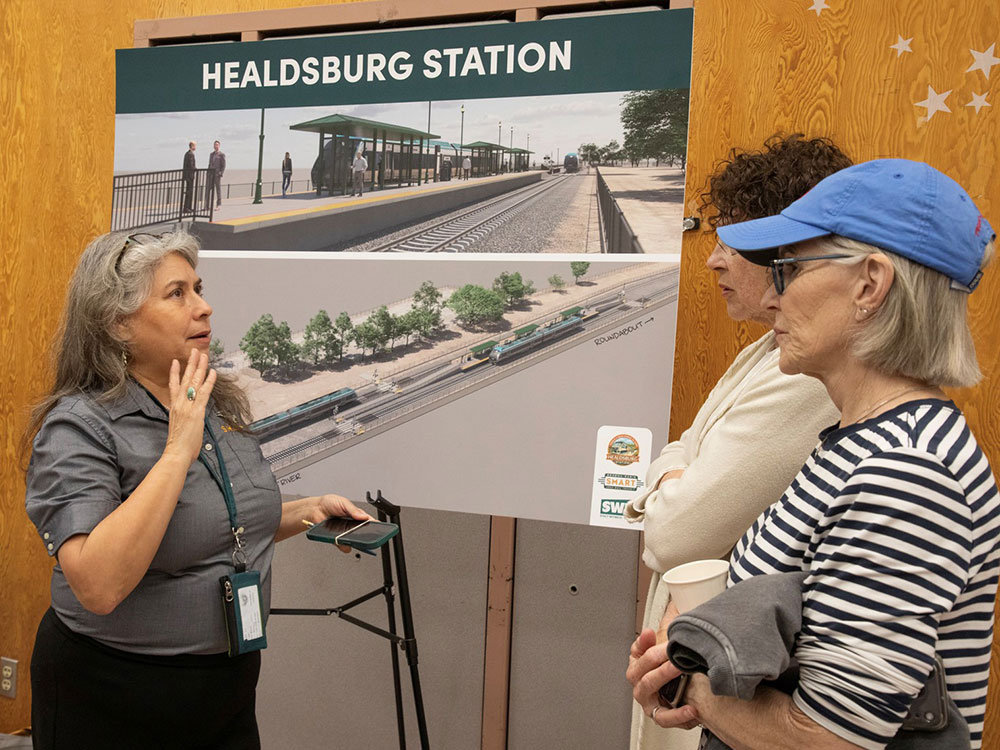
Some of that work will take place in town at various spots between Matheson Street and North Street, as well as in the Healdsburg Station area itself, at 300 Hudson St. Eventually, all that work is projected to bring service to Healdsburg by December 2028. That may seem like a long time yet to wait, but it’s been a long time coming just to get to this point.
SMART currently operates 48 miles of rail in Marin and Sonoma counties, serving 14 stations between Larkspur and Windsor. The Healdsburg station has always been on its drawing boards, as has the northernmost station in Cloverdale. That one however has yet to be funded, while the money to bring the trains to Healdsburg is already in the pipeline.
According to the agency, $269 million in funding for the Healdsburg extension has already been secured through a combination of federal, state, regional and local grants.
When it finally brings passengers to Healdsburg, the SMART train will stop at a platform at the historic Healdsburg Depot, located on Hudson Street. Though the depot building will be somewhat renovated, that’s a City of Healdsburg responsibility; SMART itself will build the platform and access for its services.
One significant upgrade along the route is the railroad bridge over the Russian River, only about a quarter mile from the station location. Monday’s meeting, held at the Abel de Luna Community Center, was the first opportunity for the Healdsburg community to see, and to some extent weigh in on, the bridge.
Troubled Bridge over Waters
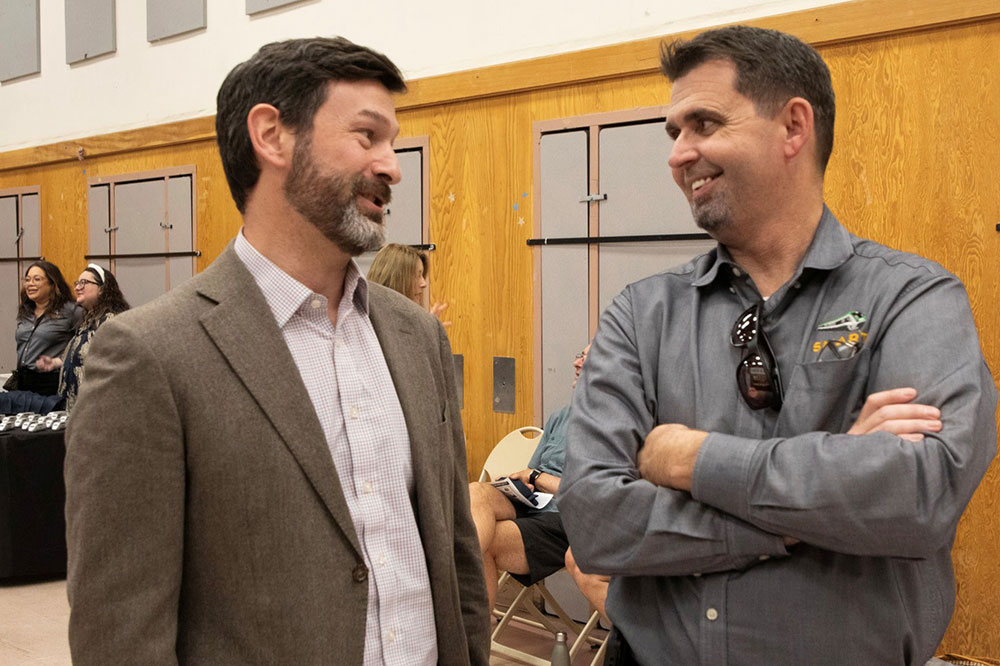
Attendees who heard about the open house, primarily through social media, filtered in from about 5pm until almost 8pm, pressing the envelope of the 5:30-7:30pm meeting. They were greeted by tables of swag—blue SMART caps, stickers, schedules and flexible SMART toy cars that looked like giant erasers (but didn’t function that way).
A full spread of fruit, cookies and cupcakes, coffee and tea helped take the edge off dinner-hour munchies.
SMART personnel—including Bill Gamlen, SMART’s chief engineer, and General Manager Eddy Cumins—circulated or stood behind tables to answer questions. There was however no opening presentation and aside from a couple of handouts (in English and Spanish), little documentation for SMART’s plans.
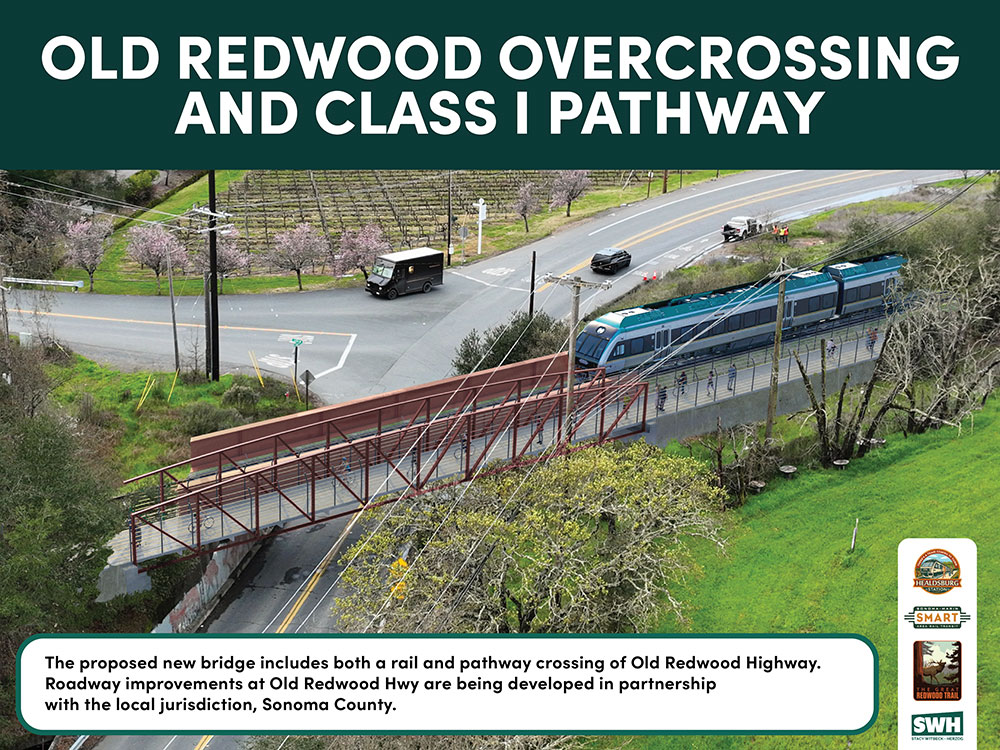
Three bridge renderings sat on easels at the far end of the community meeting room, two of them previewing the Russian River span. The third portrayed the bridge over the intersection of Old Redwood Highway and Eastside Road, south of town near Rodney Strong Winery.
The two Russian River renderings included a through-plate girder bridge, low and sleek, and a more complicated Warren Truss bridge, whose arching supports echoed the historic design of the downstream Old Redwood Highway bridge.
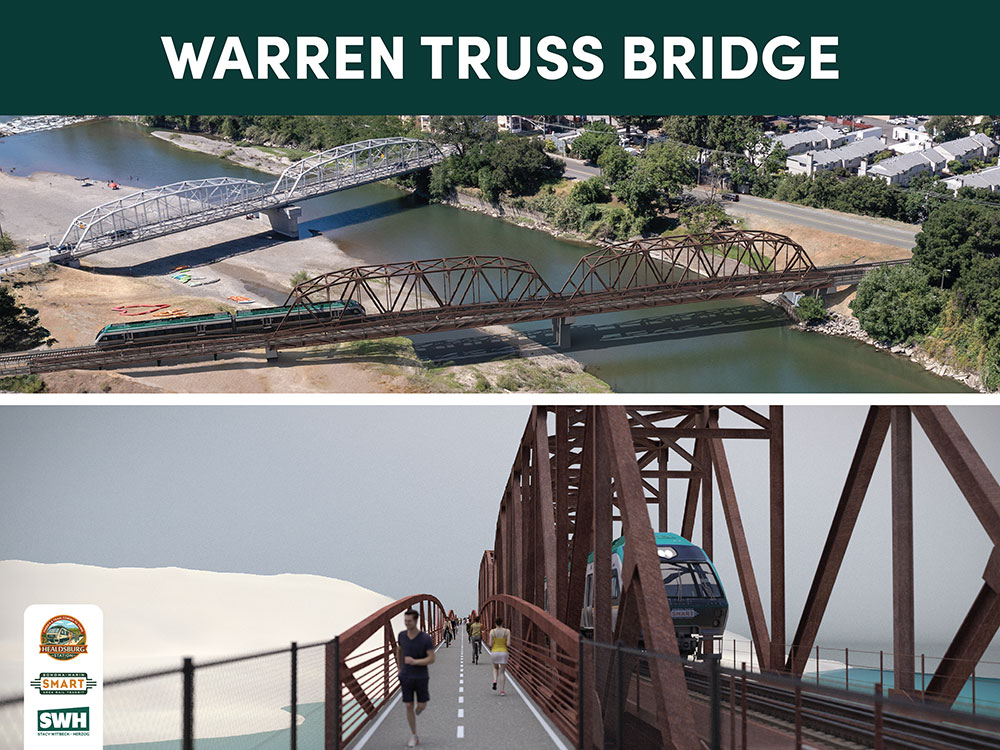
Though the images lacked budget detail or other context, the little blue dots people were encouraged to apply to their favorite design clearly lined up in favor of the Warren Truss model. The existing railroad bridge includes a Warren Truss portion, and its familiarity may have led to its popularity.
The renderings included both rail and passenger walkway, part of the SMART-wide “Pathway” that will link with Healdsburg’s own Foss Creek Trail and, eventually, the Great Redwood Trail project that extends to Eureka. The SMART Pathway is projected to be a dedicated route for people to walk, bike and roll safely within and between communities.
“They attracted a very strong turnout,” said Mayor Chris Herrod, a late arrival to the open house.“Short story is that Healdsburgers are very excited about the train. It’s the talk of the town!”
Long-range financing will continue to be an issue for SMART, supported in large measure by a quarter-cent, voter-approved sales tax that expires in 2029. To continue operations—and build out to Cloverdale—a 30-year renewal of that tax is on the June ballot as Measure B.
Locally the upgrade to the Hudson Street neighborhood that SMART’s arrival portends is the City of Healdsburg’s to deal with. To that point, the city is now actively soliciting applications for a community advisory committee to work on the SMART Station Area Specific Plan. Information about the committee’s role, and an application module, are available at healdsburg.gov/StationAreaPlan.