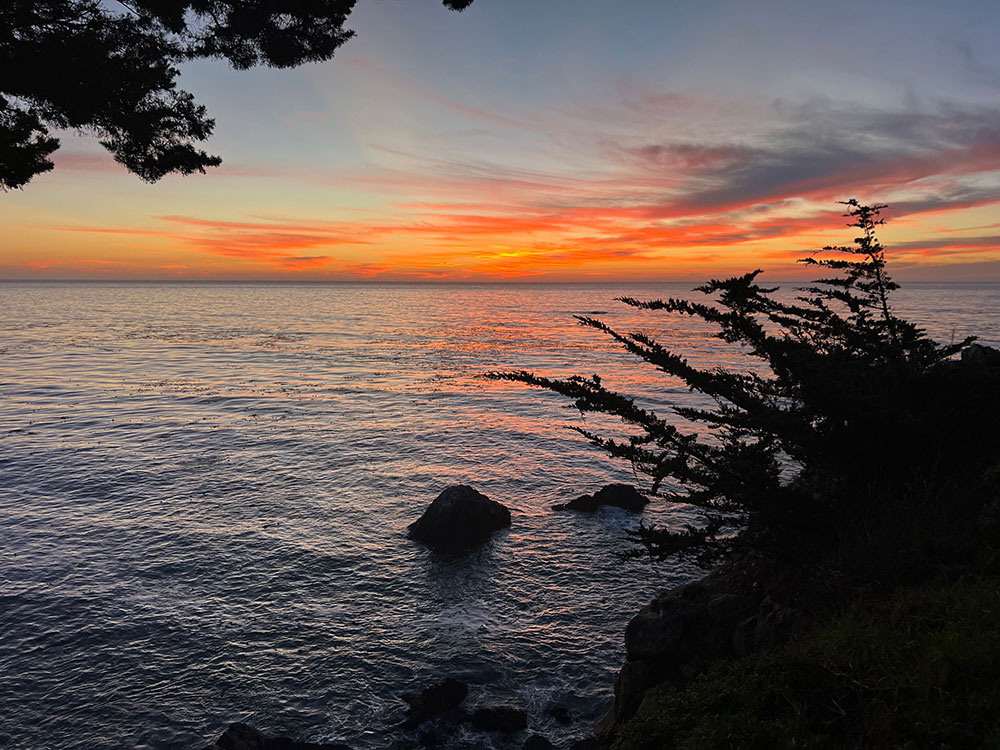
It’s mindblowing that Sonoma County is buried under a marine layer for weeks while the coast from Bodega Bay to Big Sur is sunny. Big Sur is having a spectacular streak of sunshine: no rain, no fog, no wind. Yeah, I know. Big Sur a balmy 74 degrees and Healdsburg fogged-in with high temps in the 40s? What’s up with that?
Weather is wild. Especially now, with the Pacific Northwest (PNW) experiencing a 100-year-flood event. Over 17 inches of rain fell in five days, washing out Hwy 2. An atmospheric river of warm rain melted 3 feet of existing snow in the mountains. Fifty miles of Hwy 2 is closed from mudslides, including one washing the road into the Wenatchee River. The road’s been closed for 6 days with no opening in sight. Reportedly, alternate routes are unavailable leaving many towns isolated. Climate change—big “C” or small “c”—something is going on.
Fun facts: Big Sur is known for many things: a rugged coastline, an iconic lighthouse, foggy conditions, redwoods, writers, artists, counterculture gatherings, iconic campgrounds and cozy cottage inns. Worthwhile stops include: the Henry Miller Memorial Library, Deetjen’s Big Sur Inn and the Esalen Institute.
Henry Miller was born in Brooklyn, 1891. He wrote famously scandalous books in Paris and Greece (visiting the Durrell’s) in the 1930s and ’40s, before moving to Big Sur in 1944 where he and others established a countercultural artist haven. Tropic of Cancer was published in 1934 in Paris. The book was immediately banned in the U.S., then unbanned by a 1964 Supreme Court case.
Helmuth Deetjen moved from Norway to Brooklyn in 1916, then to San Francisco where he married Helen Haight—namesake, the Haight. In 1926, Helmuth began building redwood cottages, eventually developing The Big Sur Inn, or simply Deetjen’s. Both Helmut and Helen were beloved icons known affectionately as Grandma and Grandpa. Staying in “Grandpa’s Room” with its Dutch door and pedal organ is a throwback to the Deetjen’s simpler times.
A later but fitting arrival to Big Sur’s counterculture is the Esalen Institute. Founded in 1962, Esalen promoted the Human Potential Movement, questing for personal and social transformation. Esalen’s well-funded enterprise attracted prominent speakers and thinkers, creating a vibrant workshop space for New Age philosophy, science, psychology and spirituality.