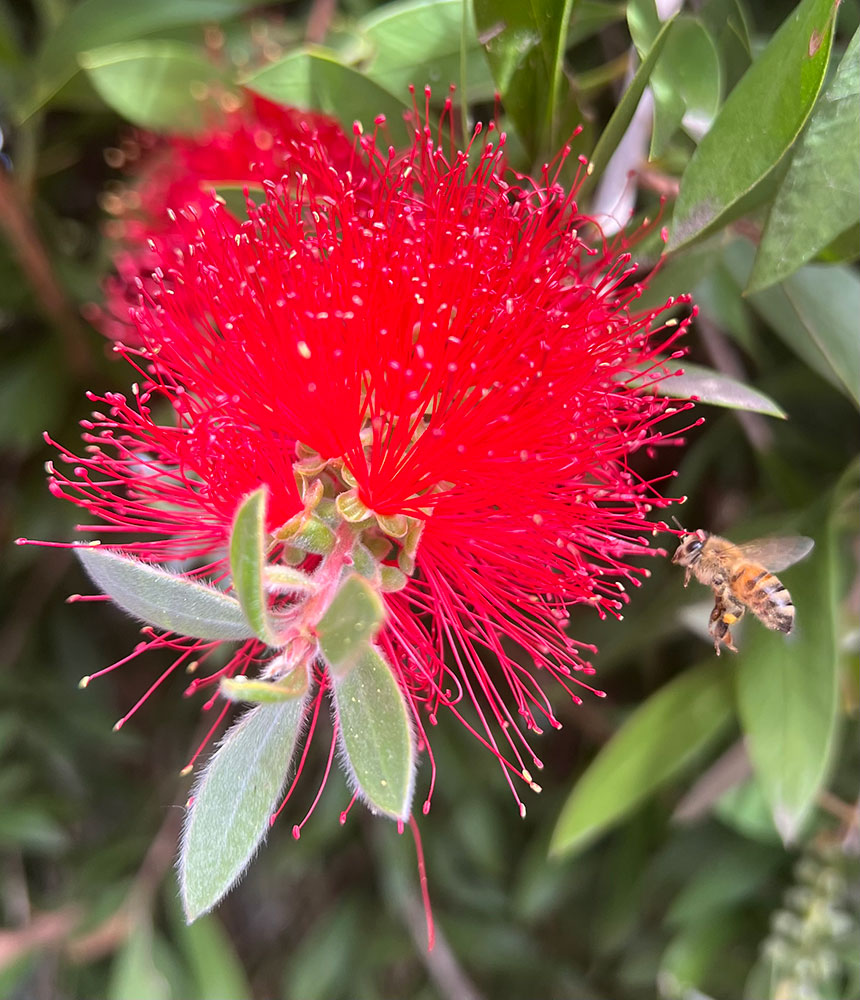
Bottlebrush (Melaleuca cintrina) is out in full bloom and the little girl in the photo (Apis mellifera) is making her rounds. Look closely. Her wee legs are filled with pollen. Pollen pockets, corbiculae, can carry 30 mg (0.001 oz), approximately 33% of this honeybee’s body weight.
Approximately 20,000 bee species are recognized globally with 4,000 native to North America. Only about 10 species are true honeybees. The other 19,990 are wild and generally solitary. They don’t create honey, store honey or have pollen pockets. They collect pollen on hairy tummy and leg patches called scopae. Living alone in tiny burrows, leaf piles and decaying logs, each female finds or makes her own nest. Despite their lonely work, solitary bees are responsible for 80% of worldwide pollination.
True honeybees, by contrast, live in large colonies with up to 50,000 mates. The forager above will visit about 3,500 flowers during her 21-day foraging duty. Flying and collecting for 8-10 hours per day, she brings in water gathered with her tongue and stored in her stomach, as well as pollen and nectar in her corbiculae. Over her lifetime she’ll produce about one-12th of a teaspoon of honey (0.8 g) as it takes approximately 2 million flower visits to produce a pound of honey.
FUN FACTS: A summer honeybee lives about six weeks and its career path is set from birth. Born, its first job is “cleaning” (3 days); cleaning its birth and other cells for eggs or storage. Its next job is “nursing” (9 days); feeding larvae, pupae and queen(s) royal jelly from special glands in its head. Then “building” (6 days); making wax by secreting scales from its abdomen which its legs pick off and fashion into cells or hive repairs. Builders can also be “undertakers,” removing dead bees from the hive.
After building, honeybees become “guards” and “fanners” (3 days), similar functions vis-à-vis hive protection: as guards defending the entrance from intruders, and as fanners regulating hive temperatures by evaporating water, releasing heat or creating heat in winter. During this phase, guards and fanners take exploratory flights outside the hive to get a lay of the land.
Lastly, the honeybee graduates to “foraging” (21 days). It’s a most demanding job, leaving the hive to collect pollen, nectar, plant resins and water, and flying about 20-40 miles per day seeking blossoms. Lifespans and job spans, like humans, vary.