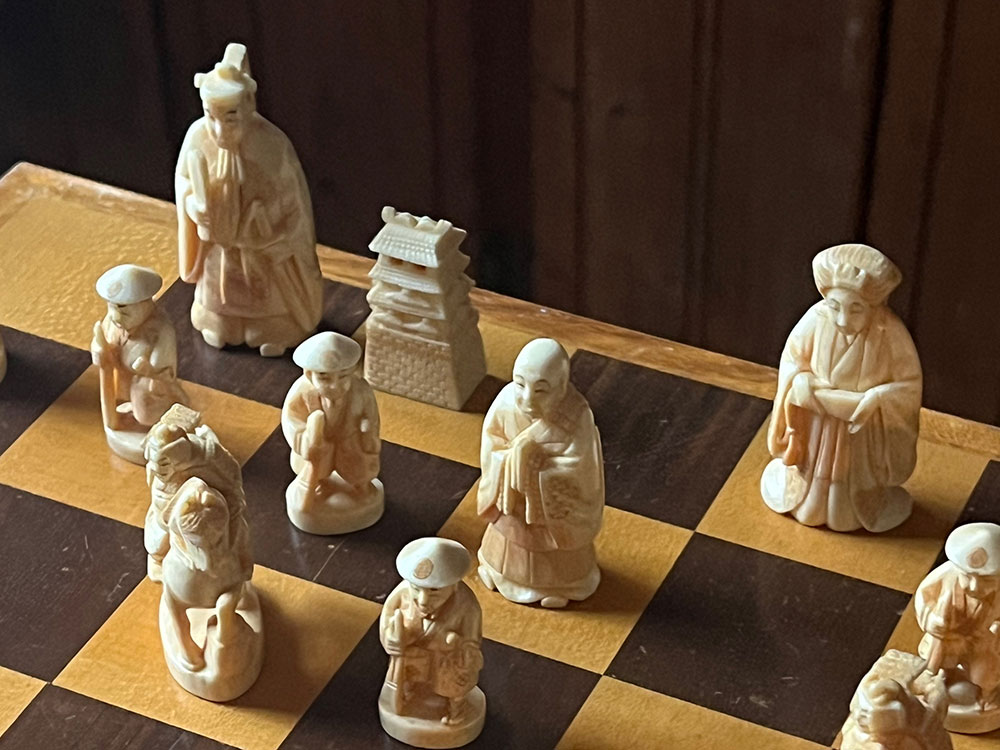
Chess is an ancient game revealing much history as it traveled and morphed across three empires. Developed in India, the original game was called chaturanga—literally four divisions of the Indian army: infantry, cavalry, war elephants and charioteers. Legend has it an Indian emperor in the Seventh century gifted the game to a Persian (Iranian) king.
Under the Persians and the Abbasid Caliphate (750-1,200 C.E.) the game became very popular. Chess entered Christian lands via trade routes in Sicily and Spain. By the 1300s the Persian shah mat (literally, king defeated) morphed into the English “checkmate.” In 1849 Britain’s great champion, Howard Staunton (1810-1874), codified the modern standard for chess pieces and in 1851 he organized the first international chess tournament.
From the first Indian-conceived chess pieces in chaturanga to Staunton’s standardized design, the Indian infantry became pawns; the cavalry, knights; the war elephants, bishops; and the charioteers, rooks. The chess set pictured above is hand-carved ivory from post-war Japan, circa 1950, representing Buddhist monks as bishops and mounted samurai as knights. The castle design is also Japanese.
FUN FACTS: The Buddhist bishop above encapsulates a full circle of history in learning and design. The renaissance of the Persian empire around 700 C.E., after the death of Prophet Muhmmad (570-632 C.E.) and the introduction of chess, did not stem from Muslim influence under the Koran so much as it did from tolerant and learned Buddhist influence. The Muslim viziers (think: Ja’fah / advisors), came from a Barmakid clan that converted to Islam but governed with Buddhist knowledge derived from Indian learning centers as in Nalanda (founded 427 C.E.), containing over 6 million manuscripts with 2,000 teachers influencing cultures from Persia to China.
When Persia—which forbade artistic depictions of living creatures—adopted chess, the war elephants morphed into a blob with a slit representing the gap between tusks. That slit later translated to bishops’ double mitered hats, hence the slit at the top of Staunton’s standardized design.
Famous and quirky chess players include: Jose Capablanca (1888-1942), a famous Cuban grandmaster who continuously smoked cigars while playing; Alexander Alakhine (1892-1946), who brought and petted his cat named “Chess”; and Bobby Fischer (1943–2008) who had all of his dental fillings removed to escape radio transmissions.
The movie Searching for Bobbie Fischer chronicles his life of chess and his 20-plus-year exile. Fischer once played 50 simultaneous games, winning 47 and drawing two, with one loss.