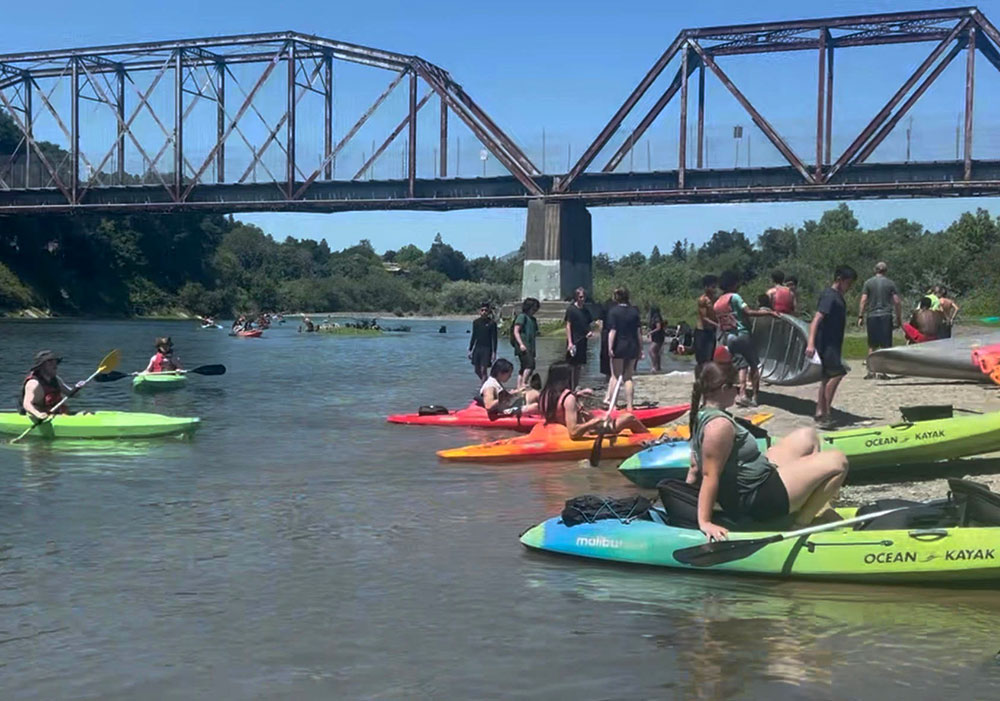
As the co-owners of River’s Edge Kayak and Canoe, we have asked SMART repeatedly for information about the planned railroad bridge over the Russian River, because we send thousands of customers paddling under the same bridge that SMART is demolishing next summer. Without a coordinated plan, mixing boaters with jackhammers seems like a pretty obvious no-no. But SMART has demurred from sharing details or timelines every month.
We fear that Healdsburg’s railroad bridge replacement project risks becoming the next place where people are asked to live with decisions that don’t include real-world experience.
We have been asking questions about the eventual building of the Russian River bridge. How close will construction activity be to paddlers and swimmers? How loud will equipment be at river level? How will people communicate with one another? What specific safety measures are planned during active construction periods?
Those are not unusual questions. What is unusual is how difficult it has been to get specific answers from SMART.
At first, they said it was too early to coordinate a plan. Then last October they said coordination of any kind was impossible because they need every available construction window to meet their timelines. But then in December they approved the final CEQA Addendum that left out any study of the actual river users in Healdsburg. This left us bewildered: How could we talk about safety measures for river users if SMART pretended river users didn’t exist?
People who spend time on the river understand something that general environmental summaries and engineering drawings do not always capture: The river is not static. Families spread out. Children drift ahead or fall behind. Paddleboards and kayaks move differently. Swimmers enter and leave the water. People call warnings to one another, point out hazards, regroup and help each other. Safety on the river often depends on communication, awareness and experience.
The concern is not whether a train should be built. The concern is that decisions affecting thousands of seasonal river users may be moving forward before some of the most basic site-specific safety questions have been publicly answered.
We’re asking that a new CEQA study be completed before the demolition and reconstruction begins that takes into account the people who actually use the river.
CEQA was created to require agencies to examine foreseeable impacts before construction begins—not after communities are already living with the consequences. It does not require perfection, and it does not prohibit projects from moving forward. It requires agencies to identify potential impacts, publicly disclose them and ask difficult questions while there is still time for solutions to exist.
Once construction begins, communities lose leverage. Safety questions are easiest to answer before work starts—not after the public is told that decisions have already been made.
If you paddle, swim, fish, float or bring your family to the Russian River, now is the time to speak up. Go to or log on to speak at the next SMART meeting, June 17 at 1:30pm. (sonomamarintrain.org/bod).
Kim Lockhart is co-owner of River’s Edge Kayak & Canoe, riversedgekayakandcanoe.com.