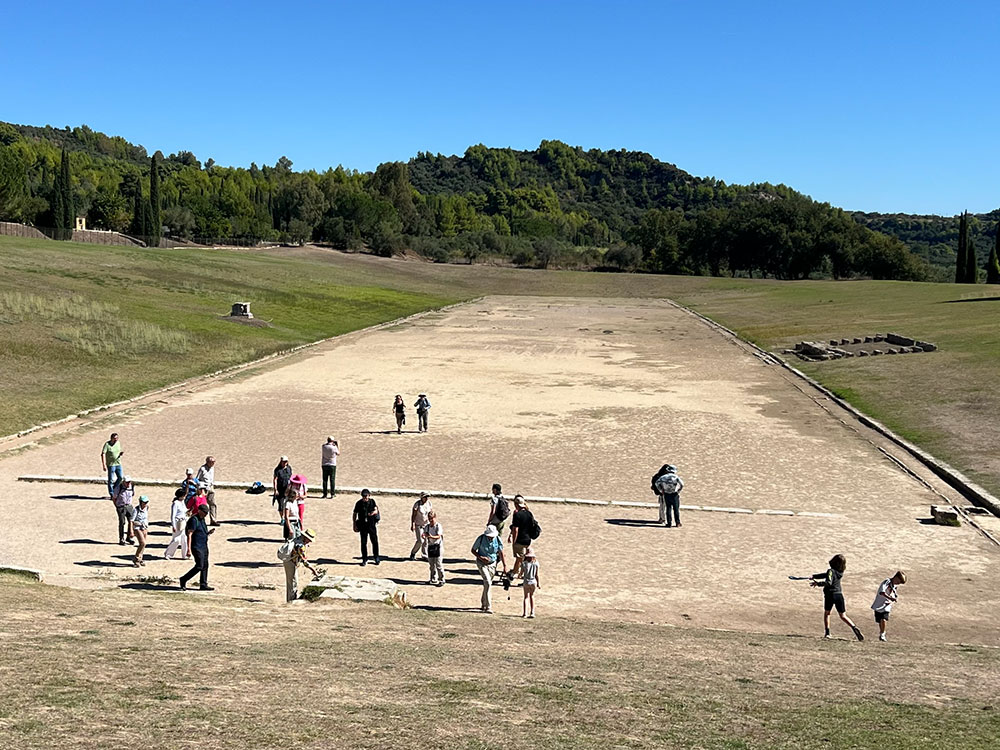
This is the original “field of dreams,” built in 776 B.C.E. in Olympia, Greece. It is, reportedly, the first stadium. Started as a clay track, its embankments accommodated 45,000 spectators after expansion by Herodes Atticus, an ancient Greek “billionaire” politician, in 140 C.E. The foreground shows the stone starting line with carved toe-grips for the 630-foot racecourse. Closer in is a stone pedestal and laurel wreath, the latter originally cut from a sacred tree and the sole prize for winning.

For nearly 1,200 years the Olympic games were held every four years. For one to three months a truce—ekecheiria, literally “holding hands”—allowed athletes and spectators to travel to Olympia. The games took place over five days. Day 1: opening ceremonies, oaths of honor for judges and athletes, religious sacrifices; Day 2: horse and chariot races; Day 3: boys athletic events and a massive sacrifice of 100 oxen to Zeus; Day 4: running races and combat sports including boxing, wrestling and the brutal pankration; Day 5: victors procession and grand banquet.
In contrast to a permanent settlement, the Pan-Hellenic sanctuary existed only to host games and honor Greek gods. The site integrated religious, athletic, social and political functions of civil and religious assembly in a unique way. UNESCO recognized it as a World Heritage site in 1989. Without overlayment of later settlement or surrounding buildings, the site eerily transports visitors to ancient times.
FUN FACTS: Stadium derives from Greek stadion, a unit of length for a foot race. Gymnasium derives from Greek gymnos, meaning naked. Athletes practiced and competed naked, glistening in olive oil, to reflect Zeus’ perfect form. Zeus was on display as a seated, 42-foot-high statue with ivory-clad skin preserved with olive-oil rubs and overlain by gold garments. The statue housed in the main temple was sculpted by Phidias in 435 B.C.E. and was one of the Seven Wonders of the Ancient World.
The 100-oxen sacrifice reportedly cost 20,000 drachmae, about $2.4 million measured in today’s wages assuming $15/hour. Women were not allowed to perform or attend the games. They had their own games, also held every four years, called the Heraean Games; men were typically not allowed. Women competed in knee-length tunics, chitons, worn with a bare right breast. The games ended in 394 C.E. when the Christian Emperor Theodosius I banned pagan festivals and cults. The ancient site was subsequently buried by river mud and not rediscovered until 1766. Systemic excavation and discovery of the Temple of Zeus did not occur till 1875.