Up close and personal. That’s the view you’ll get Thursday through Sunday at the Pacific Coast Air Museum, adjacent to the Charles M. Schultz Airport. Sonoma County’s Air History Museum preserves over 25 military aircraft in varying states of unreadiness. The raw condition of the preserved military planes opens a window on their fragility and ruggedness that is unnoticeable in polished-up commercial airliners.
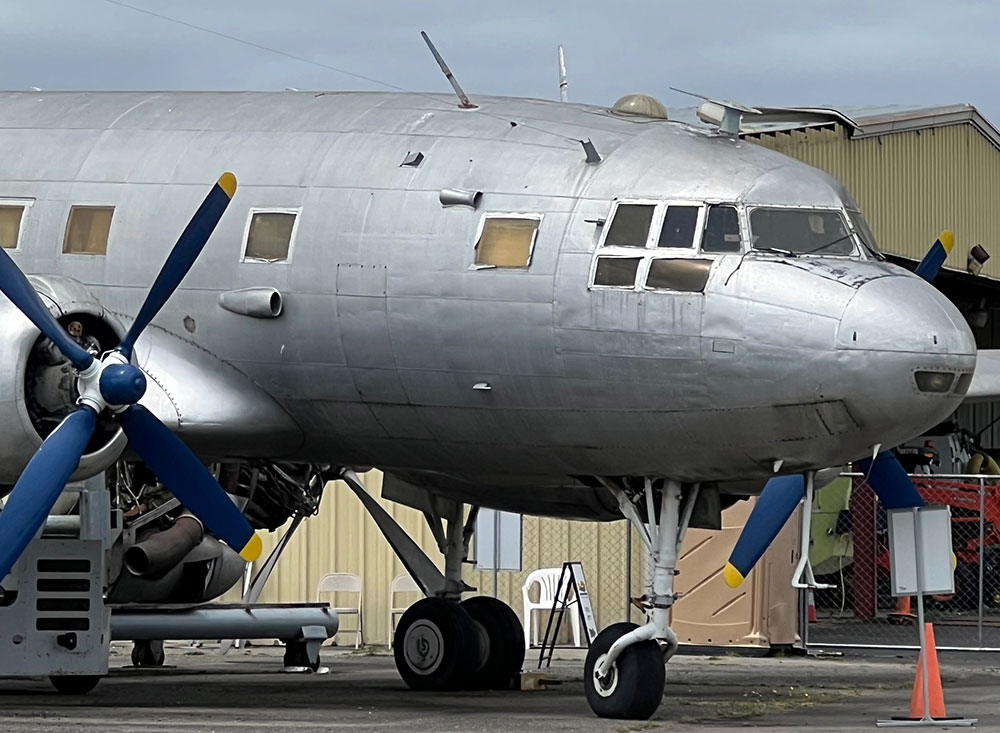
The plane pictured above is a 1950s Soviet IL-14, nicknamed the “Crate” for good reason. Check out the riveting—pun done—panels. Incredible that this was an exported Soviet product used in 31 countries! Similarly incredible is that the IL-14 is one of two planes at the museum that, reportedly, could fly again with some work. It was last flown from Reno’s Stead Air Force Base to its home at the Air History Museum in 1994.
MEMORIAL DAY FACTS: Snoopy first appeared as a World War I flying ace in 1965 in the Peanuts comic strip by Charles M. Shultz. He appeared over 400 times chasing his nemesis, the Red Baron. Snoopy’s Sopwith Camel’s last appearance was in 1999. A Sopwith Camel is a single-seat, British biplane fighter from World War I. Introduced in 1917, it was the Allies’ most deadly fighter, downing 1,294 enemy planes.
All Quiet on the Western Front (1929) by Erich Maria Remarque is a gritty telling of the gruesome inanity of trench warfare during World War I, so different from flying aces and valor. The book is considered one of the best anti-war novels by addressing the day-to-day reality of war. It is told from a German soldier’s point of view.
Bomber (1970) by Len Deighton achieves its anti-war reality by scrupulously describing the reality of a fictional day’s bombing raid on June 31 (sic), 1943. With intimate details from British and German points of view, its unsentimental realism renders the pain of war for ordinary people, civilians and military personnel alike.
Notable facts from Bomber: RAF bombs had a 20% failure rate, duds. Nighttime bombing formations, called bomber streams, 40-100 miles long with 800 planes, lost many planes and lives. RAF aircrew members had a ~50% survival rate; only 25% were physically unharmed. With no radar, and flying without lights, it was nearly impossible to see other planes. Non-combat losses accounted for 50-60% of aircraft losses during World War II; crashes approximately equaled combat losses.
Kids under 6 can visit the Pacific Coast Air Museum for free; adult admission is $10; kids under 17 admission is $5. Located at One Air Museum Way, Santa Rosa.