
Police Chief Matt Jenkins returned to the City Council last week to clarify his March presentation on the use of surveillance cameras, or “public safety camera systems” in Healdsburg. Jenkins acknowledged in March that “there are some community concerns that were surfacing” regarding recent news reports of cities and other jurisdictions having their data harvested by immigration control or other federal agencies.
Some have begun calling such comprehensive traffic data collection technology a “surveillance network” whose potential for abuse is significant. In February a class-action suit was filed in California by the Oakland-based firm, Gibbs Mura. It alleges Flock Safety violates California laws and privacy rights by sharing data on California drivers with law enforcement agencies outside the state, including federal agencies.
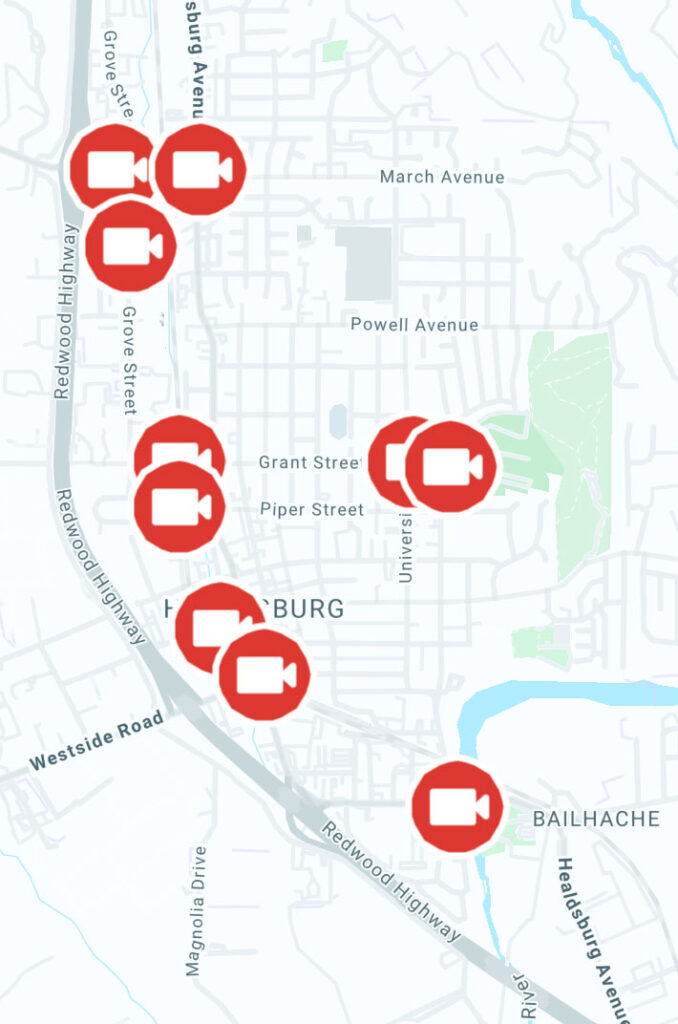
The lawsuit was widely reported, and other lawsuits and reports surfaced. Flock Safety of Atlanta, Georgia, was by far the most prevalent such data-collection company. Its nationwide network of nearly 100,000 Automated License Plate Recognition (ALPR) cameras is found in some 6,000 communities and their law enforcement agencies—including the Healdsburg Police Department.
The local Flock system is connected to a regional information network, the National Crime Information Center (NCIC), which compares license plate and other vehicle information to see if it produces a “hit” with the wider law enforcement database, as well as to alerts pushed out by neighboring agencies.
Jenkins listed several reasons a license plate would be used in law enforcement, including a vehicle being reported as a stolen car, associated with a wanted or missing person, related to a domestic violation protective order or even to “terrorist-related activity,” which remained undefined.
Follow-up
The chief returned on April 20 to report on what he discovered when he took a long, hard look at the Healdsburg’s Flock cameras and system, a line-by-line audit of the system’s record.
At present the city has 11 fixed ALPR cameras, with a 90-day retention storage. The system detects 135,000 vehicles per month and has been searched an average of 74 times per month. It costs $33,000 per year to maintain. Ten PTZ (pan-tilt-zoom) public safety cameras have only a 30 day-retention schedule and cost $45,000 a year to operate.
The ALPR cameras can recognize a license plate and the type of vehicle from its “fingerprint,” Jenkins said. They do not have facial-recognition technology, and while they can ID a vehicle’s license plate they can only tell whether “it’s a coupe or a truck, if it has a bumper sticker or a lumber rack.”
The PTZ cameras were added in 2023 as tools for criminal investigations “to help with community safety,” Jenkins said. Several of the PTZ cameras have been installed along Foss Creek Pathway, as that had been perceived as the scene of potential if not actual criminal assault.
Chief Jenkins reminded the council that larceny and theft, historically the highest victimization crimes for Healdsburg, have been in decline over the last two years. He didn’t overtly say the impact of the Flock network was a cause, though he cited crimes that a Flock report can be useful if not essential in detecting or preventing: burglary, illegal firearms recovery, stolen vehicle recovery and fraud investigations.
Downside
However Jenkins’s review of the Flock relationship was not all good news. He discovered that in one 40-minute window on Jan 11, 2023, 63 inquiries from 28 agencies were logged. An “inquiry” is a hit on the system to see if Healdsburg has records of a particular individual or license plate.
It didn’t take much investigation to find that this date was a “setup day” for “on-boarding” the system. During that 40 minutes a checkbox had been toggled that allowed unlimited outside searches.
“It was an inadvertent check,” said Chief Jenkins. “It shouldn’t have happened. I’ll take full responsibility for that.” He said it was corrected by the end of that day’s setup process, but it did call attention to a hole in the system’s installation process that allowed such a transgression to take place.
Jenkins said these queries were “concerning and also raised a lot of questions as to how this could be with where we believed things were at with the technology and our settings.”
Another bug relating to resetting the location of a jurisdiction was also eventually fixed by Flock, with Jenkins calling it “a system architecture failure on the programming side.”
In other words, the product Flock delivered was not wholly free of the kind of bugs that, for a short time at least, compromised Healdsburg’s data collection. As a result in part of Healdsburg’s experience, said Jenkins, “The vendor has taken proactive measures to make sure it doesn’t happen in the future. That checkbox is no longer able to be accessed by users.”
The results of Jenkin’s investigation only serves to underscore the legal cases being brought against Flock by other jurisdictions, as the hack-proof system they promised was subject to “system architecture failure” from the beginning.
Adding another level of concern is that Flock’s terms of service were changed at the beginning of 2026, a series of changes that the ACLU called significant. Among them: the sale of data from customer feeds.
However the City of Healdsburg is operating under previous terms of service, and they will stand until the contract is renewed.
“If the City moves forward with potential renewals, the contracts would come back before the City Council for approval after they have been reviewed by staff and the City Attorney’s office,” Chief Jenkins said.
Some cities, including Mountain View and Santa Cruz, have recently terminated their contracts with Flock, citing questions about its recent change in terms of service and fear about sharing data indirectly with ICE. There is no current indication the City of Healdsburg is considering that path.
Healdsburg Mayor Chris Herrod said, following the meeting, “I see a strong need for continued vigilance and review of our Flock camera program. But at this time it is serving Healdsburg well in helping to keep residents safe, and I continue to have unwavering faith in Chief Jenkins’s professionalism, respect for the community’s civil liberties, and his and other staff members’ oversight of the program.”