

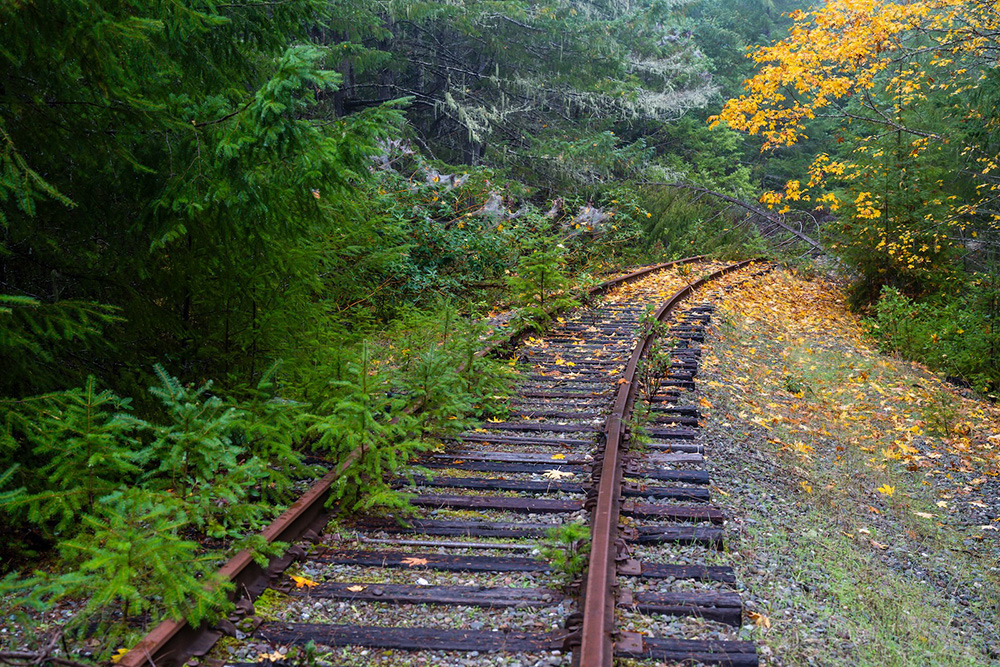
Even as the Great Redwood Trail Agency (GRTA) board gave final approval to the ambitious 300-mile rail-to-trail route across three counties, the project came face-to-face with an obstacle it was unable to avoid. Not a canyon or a gulf, nor an earthquake or a typhoon, but a little stretch of rail called the Skunk Train.
The GRTA officially adopted the Master Plan for the 231 miles of trail within Mendocino, Trinity and Humboldt counties. State Sen. Mike McGuire celebrated this milestone for the project he has advocated for since at least 2020, saying it will “help advance generational change in the North Coast, spur economic development, create jobs, and provide the public unparalleled access to some of the most stunning landscapes in the world.”
As the Sonoma-Marin Rail pushes north, the SMART Pathway paralleling the commuter rail’s route is positioned as an extension of the Great Redwood Trail, ultimately to create a 307-mile multiuse path connecting San Francisco and Humboldt bays. Approximately 17 miles of trail are currently open in Humboldt and Mendocino counties with another 40 in active planning or construction. However, the Foss Creek Pathway in Healdsburg is considered part of the network, and when the SMART pathway connects with it the resulting 4.1 miles will be added to the Great Redwood Trail.
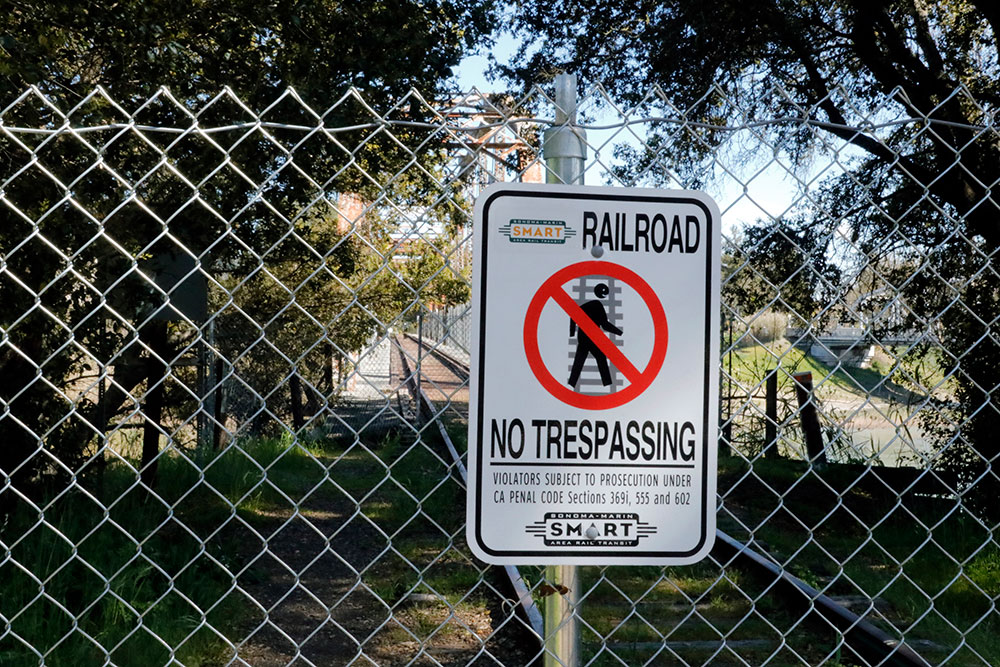
Many segments of the trail remain in the planning or proposal stage, and relatively little is currently built. That’s the point of the Master Plan, to define and formalize the project to make it eligible for funding and prioritize development according to its criteria.
The longest current section runs from Eureka to Arcata, but the Master Plan lays out the priorities for the rest to be added, segment by segment. In fact, a 3.3-mile section connecting the north to the south ends of Ukiah will be dedicated this Sunday, April 26.
The adoption of the Master Plan came in the midst of a double-barreled blow to the GRTA when the Skunk Train raised its tail. In January, the train’s Mendocino Railway won the reversal of an earlier court decision, and was allowed to “take” 20 acres in Willits from its owner, John Meyer, under the longstanding “eminent domain” rights of railways to seize private property.
Eminent Domain
“Railroads have always had in this country an incredibly powerful ability to maintain their lines as well as their right-of-ways and areas around their lines,” said Caryl Hart, a member of the GRTA board and its former chair.
Then in February, just a couple of weeks before the trail’s Master Plan was approved, Mendocino Rail convinced the federal Surface Transportation Board (STB) it was still a viable railway, with both passenger and freight traffic. That had the effect of preventing the Great Redwood Trail from using the railbed from Willits to Cloverdale for its trail network.
“It’s really an uphill battle to try to achieve an adverse abandonment over the objection of the rail line that you’re seeking to adversely abandon,” Hart said. Mendocino Railways claimed the opposite, and with the backing of the SRT, the courts began to agree. Mendocino could claim legal status as a “Class III Common Carrier” freight and passenger rail, and hence could not be seized by GRTA.
The irony, no pun intended, is that claiming ownership of abandoned rail lines across the state has been the modus operandi of the GRTA. Nearly all of the former North Coast Railroad Authority corridor along its route has been legally abandoned by the rail authority, a process called adverse abandonment. As a result, most of the former interstate rail in Northern California is now owned by GRTA, as approved by the STB.
Though the GRTA argued there had been no dedicated freight rail operations on that line since Georgia-Pacific closed its Fort Bragg lumber mill in 2002, Mendocino Railway won the day before the STB.
The Skunk Train, of all things, is proving to be the spoilsport for the GRT’s dream. “In a perfect world and as was mandated by the legislation, we would’ve moved forward with rail banking,” Hart said. “Now, at least as things exist today, we’re not able to rail bank because we’re not able to remove the rails.”
The long and the short of it is, the GRTA has had to revise its master plan to build a trail parallel to the existing rail between Willits and Cloverdale, rather than taking out the rail and replacing it with trail. Best case: The trail from Cloverdale to Willits will look a lot like the Foss Creek Trail in Healdsburg, with rail running alongside a separate trail.
“The rail is still there. I mean, you can barely see it, but it’s still there. It just runs adjacent,” Hart said. “So that’s pretty much what we will have to be looking at now going forward.”
Hart, herself once chair of the GRTA, said, “I just can’t fathom how anyone would ever be able to find the money to bring back rail. And I also don’t see where the demand would ever come from.”
She continued, “So let’s push that aside and say, ‘OK, is it more expensive to build a trail next to a rail line?’ Yes, it is. It’s more expensive.”
More information about the Great Redwood Trail Agency at thegreatredwoodtrail.org.





Caption reads “Northern Pacific Raill” where I believe it means (the former) Northwestern Pacific Railroad.
This “article” is so badly written, I can’t believe anyone really claimed to have “reported” it. Christian Kallen – are you sure your writing wasn’t overly edited?!? Please explain….