The new exhibition at the Healdsburg Museum puts history front and center in the lives of many of the museum’s visitors themselves. It’s not about 19th century horse-traders or pre-Columbian basket weaving, but the era of sex, drugs, and rock ’n’ roll: the 1970s.
“For a lot of people, they don’t think of the ’70s as being history and they are still holding onto their ’70s stuff,” said Museum Director and Curator Holly Hoods. So assembling the exhibit was more difficult than one might think. “People give us all the 1870s stuff we could handle, but 1970s people still keep their yearbooks,” she added.
After all, if one can still remember it, is it history?
The recently redesigned west wing of the Museum’s second story succeeds in demonstrating that history is composed of things that might not seem “historical,” but which certainly have a story to tell.
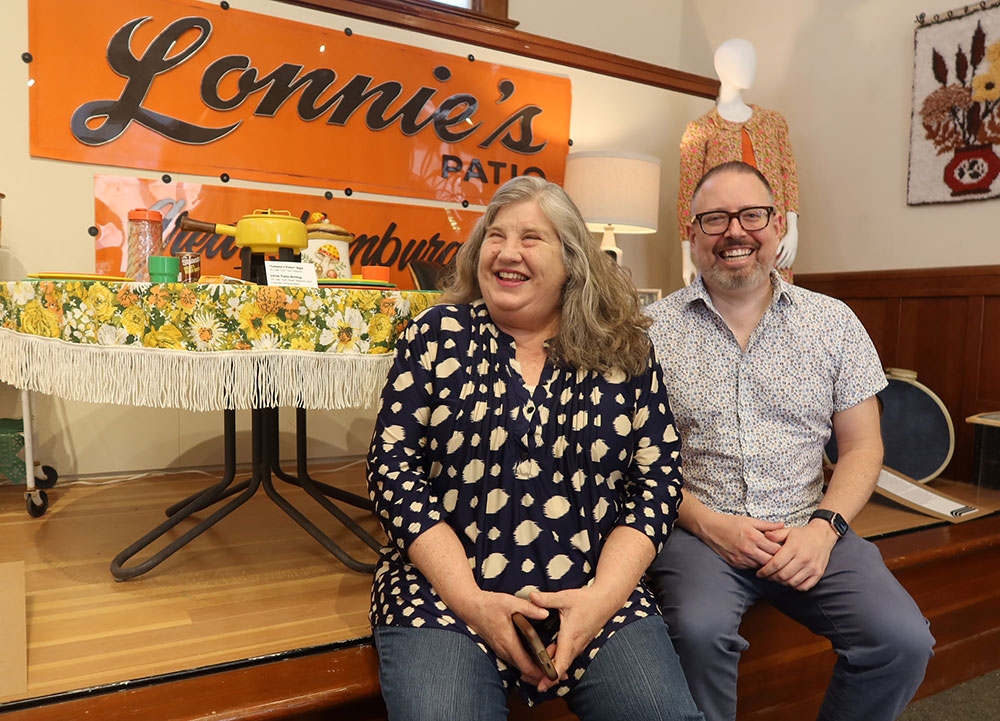
The centerpiece is a table set for lunch, 50 years ago, with colorful plasticware, a fringed daisy tablecloth over a chrome and linoleum oval table, an orange house dress, a typically tasteless table lamp and orange signs from Lonnie’s Patio (“Great Hamburgers!”) that once adorned 165 Healdsburg Ave.
That address is now Tisza Bistro; not that long ago it was Single Tree Diner. And before that it was the hub of the fictional town of South Healdsburg, where comedian Pat Paulsen launched a 1976 campaign for president on an appearance of The Smothers Brothers Comedy Hour TV show.
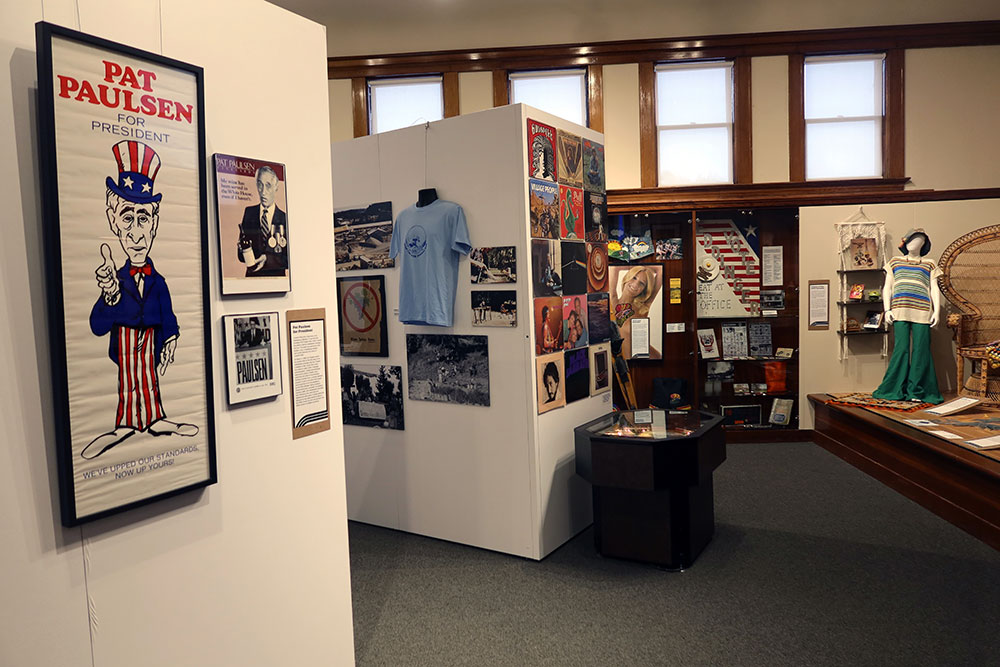
Indeed, there is the dour-faced comedian and local winemaker peering out from a campaign poster just across the aisle, with his various slogans such as “We’ve upped our game, now up yours!” It’s next to a table-top pinball game (that still works, for just a quarter) and a display of LP album covers from the era: Village People, Godspell, John Denver, Carole King’s Tapestry and others. The hits of the era even play over the museum’s sound system, for that extra-authentic feel.
“We had kind of a general idea of some of the topics that were important in the ’70s, but just kind of highlights,” said Noah Jeppson, co-curator of the exhibition. “And then as we went into everything, we realized everything in here could be its own exhibit. There’s so much depth, you know—like one trail leading us down the ceramics pathway …”
“Noah’s on the Arts and Culture Commission,” Hoods said. “Somebody else who’s involved with the commission was asking me, was I ever going to do anything about the ceramics art movement in Healdsburg. And I’m like, what? Ceramics? I didn’t know anything about it.”
In the mid-1970s a number of artists, including potters and ceramicists, found their way to Healdsburg. They included Robert Brand, Tony Evans, Robert McIntyre and Robert Weiss, and linotype artist Michael Myers and typographer Holbrook Teter. They started the fine small press Zephyrus Image, out of which emerged a political press that tackled the issues of the era like environmentalism and Vietnam’s aftermath through posters, broadsides and even stickers arguing their case in provocative visuals and slogans.
Veterans of the 1970s may remember the Briggs Initiative, a state-wide initiative to make “marriage” only legal between a man and a woman. One of the prime voices against it was Fitch Mountain Elementary School teacher Larry Berner, who “refused to surrender to the fear” and became even more open about his sexuality and a spokesman for the “No on 6” campaign.
Also in this era, an Army Corps of Engineers plan to dam Dry Creek to flood Warm Springs—an Indigenous people’s ceremonial center—drew opposition not only from archaeologists and natives but also from student environmentalists. They fought hard but unsuccessfully against the project, which eventually flooded out Warm Springs and created what we know as Lake Sonoma.
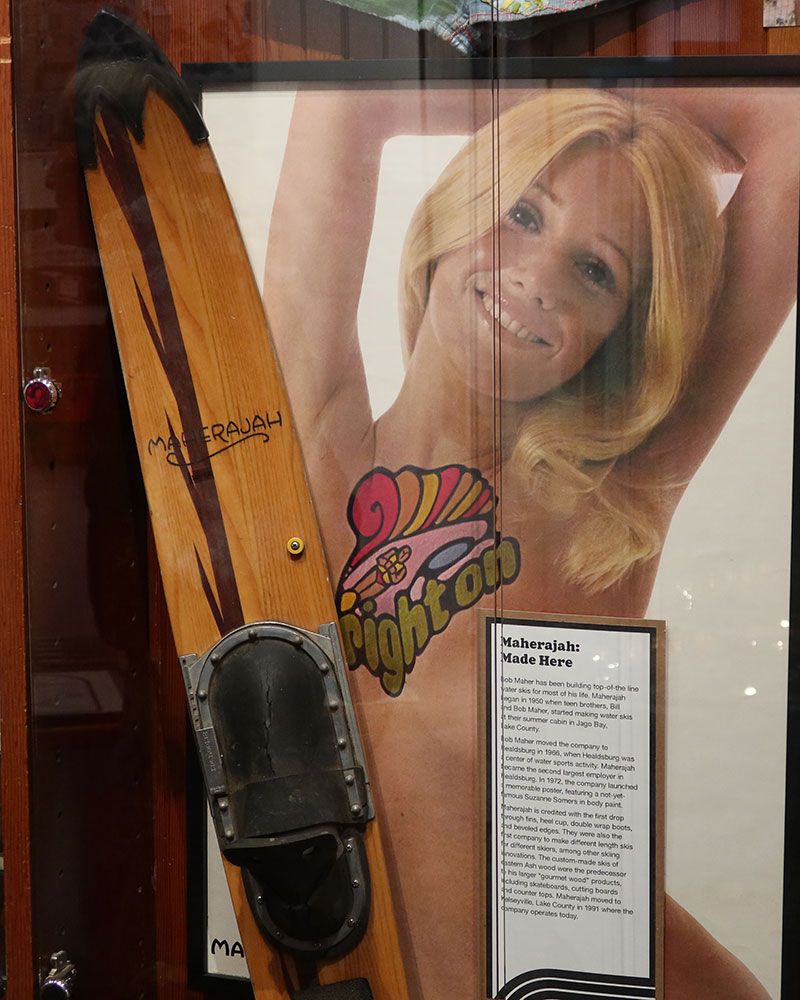
Some of the exhibits sit on handmade wooden tables into which the name Maherajah is burned. Bob Maher was a woodworker who in the middle of the ’70s introduced the fabled water ski line that leaped into public awareness when a poster featuring a topless Suzanne Somers (before she joined the cast of Three’s Company) drew attention to the single-ski craze. Yes, the poster is in the Healdsburg Museum’s exhibit, too, its highlights discretely covered by carefully placed artifacts.
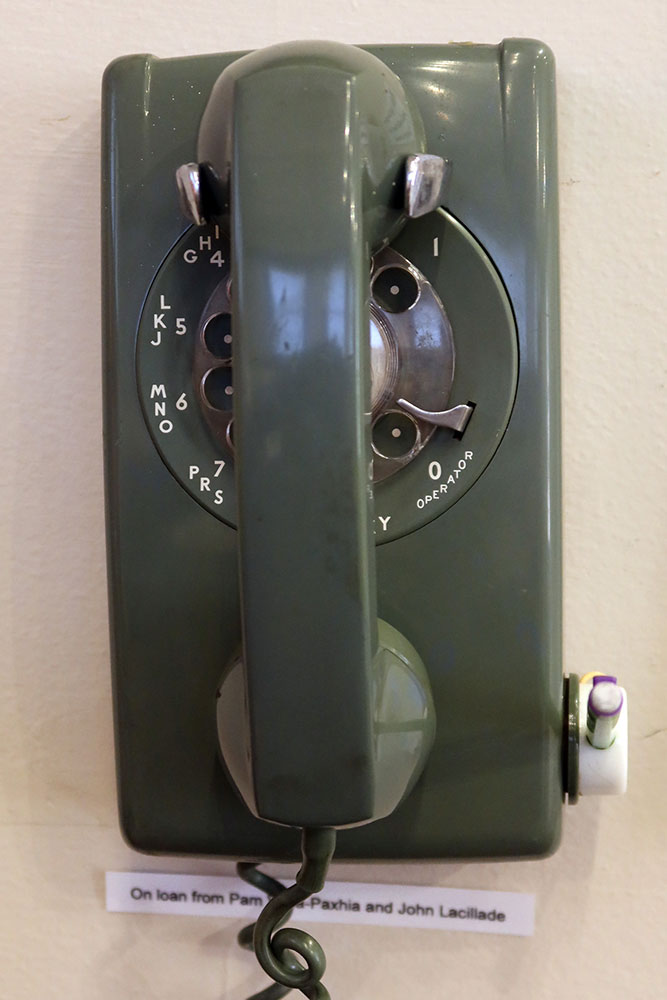
There’s even a green rotary-dial phone hanging on the wall, its coiled cord dangling from the handset.
The decade of the ’70s was not arbitrary, for the Healdsburg Museum was founded that year by Ed Langhart, who worked as city manager and city clerk from 1948-1974. His background, and immersion in Healdsburg, made him the perfect person to establish the museum. Naturally, there’s a small exhibition about him on display here.
Taking a step back to evaluate the exhibit that resulted, Hoods said, “Developers tried to come in and reinvent Healdsburg as they wanted it to, and then the community pushed back. It set up a lot of the kind of things we see today that came out of the ’70s.”
She added, “There was a lot of stuff transitioning during the ’70s, and people were like, ‘Hey, we better think this through. You know, rather than just let it happen to us, we need to plan for the future.’”
Said Hoods, speaking for the generation of 50 years ago as well as this one, “We want to go to Disneyland. We don’t want to be Disneyland.”
The Healdsburg Museum is located at 221 Matheson St., open 11am to 4pm, Wednesday through Sunday.